
Order Total (1 Item Items):
Shipping Destination:

Trees Hierarchical Structures Proceedings (14 results)
Skip to main search results
Search filters
Product Type
- All Product Types
- Books (14)
- Magazines & Periodicals (No further results match this refinement)
- Comics (No further results match this refinement)
- Sheet Music (No further results match this refinement)
- Art, Prints & Posters (No further results match this refinement)
- Photographs (No further results match this refinement)
- Maps (No further results match this refinement)
- Manuscripts & Paper Collectibles (No further results match this refinement)
Condition Learn more
- New (9)
- As New, Fine or Near Fine (3)
- Very Good or Good (1)
- Fair or Poor (No further results match this refinement)
- As Described (1)
Binding
- All Bindings
- Hardcover (No further results match this refinement)
- Softcover (14)
Collectible Attributes
- First Edition (No further results match this refinement)
- Signed (No further results match this refinement)
- Dust Jacket (No further results match this refinement)
- Seller-Supplied Images (5)
- Not Print on Demand (14)
Language (1)
Price
- Any Price
- Under US$ 25 (No further results match this refinement)
- US$ 25 to US$ 50
- Over US$ 50
Free Shipping
Seller Location
Seller Rating
-
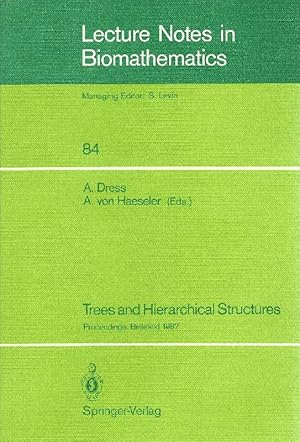
Trees and hierarchical structures Proceedings of a conference held at Bielefeld, FRG. Oct. 5 - 9th, 1987
Language: English
Published by Springer, Berlin ; Heidelberg ; New York ; London ; Paris ;, 1990
ISBN 10: 0387524533 ISBN 13: 9780387524535
Seller: Antiquariat Lücke, Einzelunternehmung, Schweinfurt, Germany
Seller rating 5 out of 5 stars

Kartoniert. Condition: Gut. 25 cm Lecture Notes in Biomathematics, 84. 137 S. Orig.-Karton. Mit graphischen Darstellungen. Gutes Exemplar.
-

Condition: Brand New. New. US edition. Expediting shipping for all USA and Europe orders excluding PO Box. Excellent Customer Service.
-
Condition: New. This is a Brand-new US Edition. This Item may be shipped from US or any other country as we have multiple locations worldwide.
-
Brand new book. Fast ship. Please provide full street address as we are not able to ship to P O box address.
-

Softcover. 137 S. Ehem. Bibliotheksexemplar mit Signatur und Stempel. GUTER Zustand, ein paar Gebrauchsspuren. Ex-library with stamp and library-signature. GOOD condition, some traces of use. C-01189 3540524533 Sprache: Englisch Gewicht in Gramm: 550.
-

Trees and Hierarchical Structures: Proceedings of a Conference held at Bielefeld, FRG, Oct. 5-9th, 1987 (Lecture Notes in Biomathematics (84)).
Seller: Wissenschaftl. Antiquariat Th. Haker e.K, Klettgau, Germany
Seller rating 5 out of 5 stars
Condition: Sehr gut. 143 p. In very good condition. ISBN: 9783540524533 Sprache: Englisch Gewicht in Gramm: 266 17,0 x 0,8 x 24,4 cm, softcover.
-

-
-
US$ 65.55
US$ 20.74 shipping
Ships from United Kingdom to U.S.A.Quantity: 10 available
Add to basketPaperback. Condition: New.
-
US$ 89.41
US$ 13.39 shipping
Ships from United Kingdom to U.S.A.Quantity: 2 available
Add to basketPaperback. Condition: Brand New. 1990 edition. 148 pages. 9.53x6.69x0.32 inches. In Stock.
-
US$ 77.25
US$ 33.48 shipping
Ships from United Kingdom to U.S.A.Quantity: 1 available
Add to basketPaperback. Condition: Like New. LIKE NEW. SHIPS FROM MULTIPLE LOCATIONS. book.
-

Trees and Hierarchical Structures : Proceedings of a Conference held at Bielefeld, FRG, Oct. 5-9th, 1987
Language: English
Published by Springer Berlin Heidelberg, Springer Berlin Heidelberg, 1990
ISBN 10: 3540524533 ISBN 13: 9783540524533
Taschenbuch. Condition: Neu. Druck auf Anfrage Neuware - Printed after ordering - The 'raison d'etre' of hierarchical dustering theory stems from one basic phe nomenon: This is the notorious non-transitivity of similarity relations. In spite of the fact that very often two objects may be quite similar to a third without being that similar to each other, one still wants to dassify objects according to their similarity. This should be achieved by grouping them into a hierarchy of non-overlapping dusters such that any two objects in ~ne duster appear to be more related to each other than they are to objects outside this duster. In everyday life, as well as in essentially every field of scientific investigation, there is an urge to reduce complexity by recognizing and establishing reasonable das sification schemes. Unfortunately, this is counterbalanced by the experience of seemingly unavoidable deadlocks caused by the existence of sequences of objects, each comparatively similar to the next, but the last rather different from the first.
-
Trees and Hierarchical Structures | Proceedings of a Conference held at Bielefeld, FRG, Oct. 5-9th, 1987
Language: English
Published by Springer-Verlag GmbH, 1990
ISBN 10: 3540524533 ISBN 13: 9783540524533
Taschenbuch. Condition: Neu. Trees and Hierarchical Structures | Proceedings of a Conference held at Bielefeld, FRG, Oct. 5-9th, 1987 | Arndt van Haeseler (u. a.) | Taschenbuch | iii | Englisch | 1990 | Springer-Verlag GmbH | EAN 9783540524533 | Verantwortliche Person für die EU: Springer Verlag GmbH, Tiergartenstr. 17, 69121 Heidelberg, juergen[dot]hartmann[at]springer[dot]com | Anbieter: preigu.
-
Condition: Sehr gut. Zustand: Sehr gut | Sprache: Englisch | Produktart: Bücher | The "raison d'etre" of hierarchical dustering theory stems from one basic phe nomenon: This is the notorious non-transitivity of similarity relations. In spite of the fact that very often two objects may be quite similar to a third without being that similar to each other, one still wants to dassify objects according to their similarity. This should be achieved by grouping them into a hierarchy of non-overlapping dusters such that any two objects in ~ne duster appear to be more related to each other than they are to objects outside this duster. In everyday life, as well as in essentially every field of scientific investigation, there is an urge to reduce complexity by recognizing and establishing reasonable das sification schemes. Unfortunately, this is counterbalanced by the experience of seemingly unavoidable deadlocks caused by the existence of sequences of objects, each comparatively similar to the next, but the last rather different from the first.


