Order Total (1 Item Items):
Shipping Destination:

Two Letters Dated June July (1 results)
Skip to main search results
Search filters
Product Type
- All Product Types
- Books (1)
- Magazines & Periodicals (No further results match this refinement)
- Comics (No further results match this refinement)
- Sheet Music (No further results match this refinement)
- Art, Prints & Posters (No further results match this refinement)
- Photographs (No further results match this refinement)
- Maps (No further results match this refinement)
- Manuscripts & Paper Collectibles (No further results match this refinement)
Condition Learn more
- New (No further results match this refinement)
- As New, Fine or Near Fine (No further results match this refinement)
- Very Good or Good (1)
- Fair or Poor (No further results match this refinement)
- As Described (No further results match this refinement)
Binding
- All Bindings
- Hardcover (No further results match this refinement)
- Softcover (No further results match this refinement)
Collectible Attributes
- First Edition (No further results match this refinement)
- Signed (No further results match this refinement)
- Dust Jacket (No further results match this refinement)
- Seller-Supplied Images (1)
- Not Print on Demand (1)
Language (1)
Price
- Any Price
- Under US$ 25 (No further results match this refinement)
- US$ 25 to US$ 50 (No further results match this refinement)
- Over US$ 50
Free Shipping
- Free Shipping to U.S.A. (No further results match this refinement)
Seller Location
Seller Rating
-
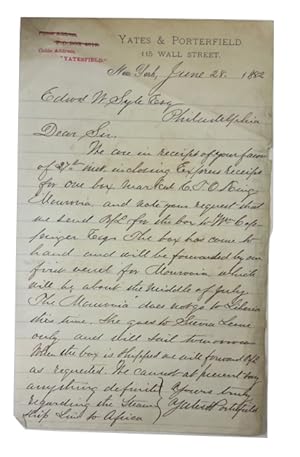
Two letters dated June 28 and July 10, 1882 to Syle from Yates & Porterfield about Syle's Request that Yates & Porterfield ship boxes of books to Liberia. Also an unsigned 1887 letter or draft written by Syle about Gallaudet and deaf marriage
Seller: McBlain Books, ABAA, Hamden, CT, U.S.A.
Association Member: ABAA ILAB SNEAB
Seller rating 5 out of 5 stars

Condition: Very Good. Letterhead stationery for Yates & Porterfield, 115 Wall Street, [NYC]. One is letter size (27 cm, 1+ page) and the other is ruled personal size (24 cm., 1 page). We know from other material we have had that Syle was Corresponding Secretary to the Pennsylvania Colonization Society and also acted as a financial agent for the American Colonization Society. The boxes of books were probably being sent by Syle acting in one of those capacities. He is advised in the June letter that the box received cannot be sent via the Bark Monrovia since that ship was leaving the next day for Sierra Leone and would not be stopping in Liberia. Yates & Porterfield agree to send the bill for shipment to a named third party. Syle is further advised that Yates and Porterfield is unable to say anything definite about a Steam Ship Line to Africa. The July letter advises that Syle can send a box of books (apparently a second one) at any time up to the 25th. The letter also says that the next vessel is likely to depart around July 1st (but probably means August 1st). Syle is advised that there would be no charge for shipment of the books if they were for the use of the College or schools. He is also told that the Bark Monrovia arrived with several passengers recently, some of whom were returning immigrants, one of whom is referred to by name -- not deciphered by us -- is said to have gone on to Charleston to join her husband who had returned from Liberia the previous year. The letter closes with a statement that Yates & Porterfield were still unable to say anything definite about the proposed Steam Ship Line to Africa. Also included is an unsigned letter (or draft of a letter), probably from Syle, urging an unnamed recipient to accept the invitation to speak at the Gallaudet Commemoration and to not be deterred from speaking by harsh things some were saying about the recipient over a position or something written or said about the marriage of deaf persons. The letter or draft is dated 9 Nov. 1887 with a return address of 2142 Mt Vernon St, Phila. Syle's son, Henry Winter Syle became deaf as the result of scarlet fever at the age of six which led to the father's lifelong interest in education for the deaf. Son Henry graduated from Yale University (B.A. in 1869 and M. A in 1872), becoming the first deaf man to get a degree from a hearing college. He later became the first deaf priest (Episcopal) in the United States.