
Unity Vol: Signed (4 results)

Language: English
Published by Champaign (IL): University of Illinois Press 1979
- Softcover
- Signed
Seller: Borkert, Schwarz und Zerfaß GbR, Berlin, GermanyBorkert, Schwarz und Zerfaß GbR
Contact seller5-star sellerCondition: Used - Very good
US$ 22.65
US$ 46.29 shippingShips from Germany to U.S.A.Quantity: 1 available
Reprint, stapled. Condition: Gut. pp. 158-177. From the library of Prof. Wolfgang Haase, long-time editor of the ANRW and the International Journal of the Classical Tradition (IJCT). - With dedication by the author to W. Haase. - Author's name handwritten on first page, back page light-margined, otherwise clean. - From the text:… The theme of treacherous friendship recurs throughout all sixteen of Juvenals Satires.1 Amicitia and the adjective amicus are in every instance used by the satirist ironically; and only in a very few of as many as thirty-nine occurrences does the noun amicus bear an interpretation of honest camaraderie. Among the friends of Books Two through Five there are niggardly patrons, avaricious, self-serving clients, sexual degenerates and eunuchs, thieves, and others we might call at best fair-weather friends. The alliance depicted is nearly always in fact an unfriendly bond between men somehow unequal. Most often Juvenal has in mind the miserably eroded state of the patronage system; he employs the term amicus for both cliens and patronus, but he always underscores the paradox of applying this traditional label to the frequently impersonal and sometimes overtly antagonistic patron-client relationship. Through all the later books Juvenals picture of friendship in general, and of patronage in particular, is consistently dismal. Sprache: Englisch Gewicht in Gramm: 550.
Language: English
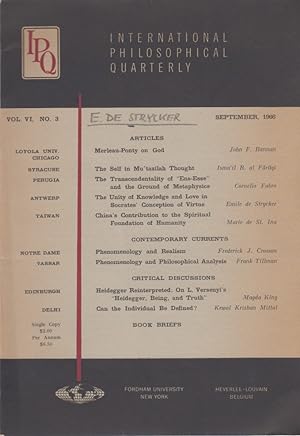
Published by New York: Fordham University, Heverlee-Louvain: Berchmans Philosophicum 1966
- Softcover
- Signed
Seller: Borkert, Schwarz und Zerfaß GbR, Berlin, GermanyBorkert, Schwarz und Zerfaß GbR
Contact seller5-star sellerCondition: Used - Very good
US$ 22.65
US$ 46.29 shippingShips from Germany to U.S.A.Quantity: 1 available
Reprint. Condition: Gut. pp. 428-444 From the library of Prof. Wolfgang Haase, long-time editor of ANRW and the International Journal of the Classical Tradition (IJCT). - With dedication by the author. - Cover light edged, author's name handwritten on cover, otherwise good and clean. - From the text: The textbooks of history of…philosophy generally characterize the ethics of Socrates as intellectualistic and deterministic. If we are to believe them, for Socrates virtue equals science. A man is courageous when he knows what to fear and not to fear; self-control or moderation consists in the knowledge of the exact extent to which a man ought to follow or to resist his inclinations, and so on. He who knows about these or similar norms, or, to put it even more radically, he who is able to express, in a definition, the real nature of virtue in general, or of a particular virtue, has all that it takes to be a virtuous man. Moreover, such a person cannot do wrong; the right way of acting follows necessarily upon the right way of thinking. That is why Socrates conceptions are considered utterly paradoxical. In order to attenuate this paradox, the historians occasionally refer to an intellectualistic trend in archaic Greek ethics; they insist especially, however, on Socrates exceptionally strong moral personality: for his|righteous mind it was inconceivable that somebody should know the good and not do it. This traditional conception of Socrates position derives from Aristotle. Sprache: Englisch Gewicht in Gramm: 550.
Language: English
Published by Versch. Verlage, 1994
- Signed
Seller: Antiquariat am Ungererbad-Wilfrid Robin, München, GermanyAntiquariat am Ungererbad-Wilfrid Robin
Contact seller5-star sellerCondition: Used - Very good
US$ 14.90
US$ 26.04 shippingShips from Germany to U.S.A.Quantity: 1 available
Condition: Gut. Erstauflage der Sonderdrücke. * mit 10 Widmungen an d. Prof. Ernst Vogt, München. Sprache: Englisch Gewicht in Gramm: 505 Gr.-8°, 8°, Or.-(Varia)-LeichtKarton./Papier-Heft mit Teils Klammern. Gut erhalten insges.

Published by Oxford: Clarendon Press. 1957
- Signed
Seller: Wittenborn Art Books, San Francisco, CA, U.S.A.Wittenborn Art Books
Contact seller5-star sellerCondition: Used - Good
US$ 50.00
US$ 10.00 shippingShips within U.S.A.Quantity: 1 available
Condition: Good. REPRINT. 8vo. 113-126 pp., Very Good, Stapled Section with sun-fading, yellowing, minor shelf wear. Signed by the author, dedicated to UC Berkeley professor Bertrand "Bud" Harris Bronson, specialist in Chaucer and Samuel Johnson.


