

Order Total (1 Item Items):
Shipping Destination:

When Always, Signed (7 results)
Skip to main search results
Search filters
Product Type
- All Product Types
- Books (6)
- Magazines & Periodicals (No further results match this refinement)
- Comics (No further results match this refinement)
- Sheet Music (No further results match this refinement)
- Art, Prints & Posters (No further results match this refinement)
- Photographs (No further results match this refinement)
- Maps (No further results match this refinement)
- Manuscripts & Paper Collectibles (1)
Condition Learn more
- New (No further results match this refinement)
- As New, Fine or Near Fine (4)
- Very Good or Good (3)
- Fair or Poor (No further results match this refinement)
- As Described (No further results match this refinement)
Binding
Collectible Attributes
Language (2)
Free Shipping
Seller Location
Seller Rating
-

God Is Always at Work Even When You Do Not Know It!
Seller: Wonder Book, Frederick, MD, U.S.A.
Seller rating 5 out of 5 stars

Signed
Condition: As New. Signed Copy . Inscribed by author on title page.
-

When A Child Becomes the Four Year Old Parent.Trouble Don't Last Always
Seller: Wonder Book, Frederick, MD, U.S.A.
Seller rating 5 out of 5 stars
Signed
Condition: Very Good. Signed Copy . Inscribed by author on front endpage. (abandoned children--biography, foster children, child welfare workers).
-

I Always Faint When I See a Syringe! - SIGNED
Language: English
Published by Silver Tree Books, Silverton, OR, 1996
ISBN 10: 0963176919 ISBN 13: 9780963176912
Seller: UHR Books, Hollis Center, ME, U.S.A.
Association Member: MABA
Seller rating 5 out of 5 stars
First Edition Signed
Paperback. Condition: Near Fine. No Jacket. First Edition. SIGNED by AUTHOR. Nurse student tales, written by a professor of nursing. "A warm hearted look at the nursing profession. . . humor, insight and stories about real people.". SIGNED BY AUTHOR. Book.
-

Soft cover. Condition: Fine. 11th. Gift Inscribed And Signed By Authhor. Inscribed by Author(s).
-
Five petticoats on Sunday [Prophet's room always ready -- Threshing time in the nineties -- the old smoke house -- The day of the long johns shedding the heavies -- The old time wash place -- The surrey with the fringe -- The coffee grinder -- The old churn dasher -- Foot peddlers brought riches of Araby in their packs -- The old country store -- Day o the button shoe -- Waiting for second table -- Homes remedies down on the farm -- When bustles were in style -- Sassafras tea -- Passing of the Amen Corner -- Roof covering -- Old Saturdays in Cotton Town -- Day of the traveling dentist -- When Grandma laced -- The Big Ha Bible -- Cotton picking time in Dixie -- Hog killing time ont he farm -- Old time corn shuckings -- Christmas in the 90s]
Published by Hiott, Greenville, S.C., 1962, 1962
Seller: Joseph Valles - Books, Stockbridge, GA, U.S.A.
Seller rating 5 out of 5 stars
First Edition Signed
Hardcover. Condition: Fine. Dust Jacket Condition: Fine. 1st Edition. [1st ed., 1st printing ] ; xv, 145 pages, 1 unnumbered leaf of plates : illustrations ; 24 cm OCLC 8240073 ; SIGNED presentation by the author, on half-title ; green cloth in pick and white dustjacket ; Contents: Five petticoats on Sunday -- Prophet's room always ready -- Threshing time in the nineties -- the old smoke house -- The day of the long johns shedding the heavies -- The old time wash place -- The surrey with the fringe -- The coffee grinder -- The old churn dasher -- Foot peddlers brought riches of Araby in their packs -- The old country store -- Day o the button shoe -- Waiting for second table -- Homes remedies down on the farm -- When bustles were in style -- Sassafras tea -- Passing of the Amen Corner -- Roof covering -- Old Saturdays in Cotton Town -- Day of the traveling dentist -- When Grandma laced -- The Big Ha Bible -- Cotton picking time in Dixie -- Hog killing time ont he farm -- Old time corn shuckings -- Christmas in t he nineties -- The old fashioned garden -- The straw broom -- The fly brush -- The split bonnets were enduring -- Avoid water during the dog days -- The cedar water buckets -- Hoecakes on the hearthstone -- The straw bed -- Lay by time on the farm -- Sweet gum chewing -- The quilting party -- Big hominy -- Cleaning the lamp chimneys -- The traveling gin -- The country doctor family physician of the old school -- Making sorghum syrup -- Making lye soap -- Old time hustings -- The old rail fence -- Sitting till bedtime lightwood knot fire -- Spring cleaning in Grandma's day -- Hilling the potatoes -- In the days of log-rollings -- Old country schools and half moon pies -- The day the preacher came -- Winter wedding and infare -- Grandma's cures for cold and quinsy -- Bliss of shedding copper toed shoes -- Early American dye pot -- The old time hats -- The house amid the honeysuckle vines -- Day of the curealls -- Christmas in the sixties -- Hat pins -- The sack dress -- Confederate mothers -- The black gum tooth brush -- Brush-arbor Church -- Naughts -- Protracted meetings -- Lawn parties -- Pound parties and twistification -- Beauty aids in the naughts ; A collection of articles written by Mrs. Caroline S. Coleman for the "Greenville Piedmont" newspaper about reminiscences related to her Grandmother and the lives of friends and family in the Piedmont of South Carolina as early settlers can and developed this area ; some foxing, else FINE/FINE. Signed by Author(s). Book.
-
Athenian sport: or, Two thousand paradoxes merrily argued, to amuse and divert the age: as a paradox in praise of a paradox. Corporeal affections remain after separation. The eye beholds as much when it looks on a shilling, as when it speculates the whole Heaven. Inconstancy is a most commendable virtue. Every man is corporally born twice. No man sees but he that is stark blind. The restorÆd maidenhead, or a marryÆd woman may be twice a virgin. Athenian, or intellectual, sport is the recreation of pre-existent spirits. ætis the pleasantest life to be always in danger. The same numerical voice of a preacher is not heard by any two of his auditors. What we call life, is natural death. Content is the greatest misery. He is the happiest man
Published by London: printed for B. Bragg in Pater-noster-row, 1707
First Edition Signed
US$ 309.16
US$ 29.35 shipping
Ships from United Kingdom to U.S.A.Quantity: 1 available
Add to basketHardcover. Condition: Very Good. 1st Edition. 1st ed. xxxii, 544p. Early half-calf, but front board holding on cords and back board detached. Preface signed: Philaret, i.e. John Dunton. Bound with the half-title. An uncommon title. Signed by Author(s).
-
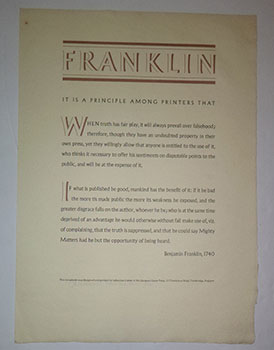
Franklin. It is a Principle among Printers that when Truth has fair Play, it will always prevail over Falsehood. First edition of the Rampant Lions Press Broadside.
Published by Cambridge, England: Rampant Lions Press , circa 1960s, 1960
Seller: Wittenborn Art Books, San Francisco, CA, U.S.A.
Seller rating 5 out of 5 stars
Manuscript / Paper Collectible First Edition Signed
Condition: Good. Letterpress on rag paper watermarkd A. Millboard.Signed presenation copy to Raymond Gid."Statement of Editorial Policy"The Pennsylvania Gazette, 24 July 1740: It is a Principle among Printers that when Truth has fair Play, it will always prevail over Falsehood.Therefore, though they have an undoubted Property in their own Press, yet they willingly allow that anyone is entitled to the Use of it who thinks it necessary to offer his Sentiments on disputable Points to thePublick, and will be at the Expense of it. If what is thus publish'd be good, Mankind has the Benefit of it.If it be bad (I speak now in general without any design'd Application to any particular Piece whatever)the more 'tis made publick, the more its Weakness is expos'd, and the greater Disgrace falls upon theAuthor, whoever he be, who is at the same Time depriv'd of an Advantage he would otherwise withoutfail make use of, viz. [namely] of Complaining that Truth is suppress'd, and that he could say MIGHTYMATTERS, had he but the Opportunity of being heard.Sebastian Carter was born in 1941 in Cambridge, England. He was educated at Christ's Hospital, and King's College, Cambridge, reading English and Architecture and Fine Arts. He then worked as a designer with the London publisher John Murray, followed by two years in Paris with the Trianon Press. Back in London he worked for the Stellar Press and Ruari McLean Associates, as well as working freelance. In 1966 he married Penelope Kerr and moved back to Cambridge to join his father Will Carter at the Rampant Lions Press. He became a partner in 1971 and took over the business in 1991, retiring in 2008.Alongside his work at the Rampant Lions Press, Sebastian Carter has written extensively on typographical and other subjects, beginning with editing the Christ's Hospital literary magazine The Outlook, and continuing with contributions to Granta at Cambridge. He has contributed to 25 out of the 29 numbers of the Whittington Press's journal Matrix so far, and in 2008 took over the European editorship of Parenthesis, the journal of the Fine Press Book Association, from Dennis Hall. He writes occasional reviews for The Times Literary Supplement, and The Book Collector.In 1982 he produced the first catalogue of the Rampant Lions Press's output for the exhibition of the Press's work at the Fitzwilliam Museum in Cambridge, and he is currently working on a full catalogue of all the books printed at the Press, to be published to coincide with another Fitzwilliam exhibition planned for 2015.In 1984 he wrote The Book Becomes, an account of the printing at the Rampant Lions Press of William Morris and Burne-Jones's Story of Cupid and Psyche (1974), with a discussion of broader issues of fine printing.The first edition of his Twentieth Century Type Designers was published by Trefoil (and Taplinger in the USA) in 1987, and it has been continuously in print since then, becoming the standard work. A second edition was published by Lund Humphries (Norton in the USA) in 1995, and a paperback edition in 2002.Provenance: from the estate of Raymond Gid who died Sunday November 12, 2000 in Paris. Born on November 25, 1905, Raymond Gid became first known through his posters, after having studied at les Beaux-Arts. As a film enthusiast, he designed many movie posters, for example Vampyr de Dreyer (photomontage, 1932), Le Silence de la mer by Melville (1949), Les Diaboliques by Clouzot (1955). But a meeting with Guy Levis Mano (editions GLM), editor and typographer, soon directed Gid towards the book. In 1935, he publishes, together with the photographer Pierre Jahan Devot Christ de Perpignan and Chats, Chiens by Ylla. It is an intensive period of his life period: he meets Dufy, Corbusier, Hake, Lurcat and receives the gold medal for a poster at the International exhibition of Paris (1937). He reacts to the Civil War in Spain with a poster " Help to the civil populations ". Together With Father Carre, « bete-a-bon-Dieu » of the Resistance, Raymond Gid began to design liturgical texts. Apocalypse Six (an extract of the biblical text of Saint John) appeard after the war. It is one of his major works, composed in the Peignot typeface, which was designed by Cassandre in 1937. He designs several post-war period posters, for example Week of absent, a simple Lorraine cross surrounded by barbed wire on a dark background. Right from the beginning of the symposiums in Lure (Provence) in 1954, Raymond Gid participates in discussions on typography, particularly with Maximilen Vox, Charles Peignot, Roger Excoffon. Raymond Gid puts on page and illustrates the Dialogues of the Carmelite nuns by Bernanos (1954), then some pages in Caractere Noel 1955, dedicated to his friend Jan van Krimpen, the creator of dutch type faces. He plays with the breathing of the text, in the manner of Mallarme, as in his Book of hours (1959) or his Apocalypse (1964), adapting medieval text to present day tastes. He also designs posters like those for the Club Mediterranee (1961), Bally (1976) or, heavier fare, like that of Amnesty International (1973). During his whole life, Raymond Gid remained attached to the typographical arts. He liked to try out new characters in his compositions, mixing them with his very free drawings, as for example in Messidor published by the Imprimerie nationale (1989). Jean-Francois Porchez, type designer; translated from french by Babelfish and cleaned up a bit. Links Art and Poster Bally posters Chicago Center for the Print Bally posters Poster Auctions International, New York Catalogue from the personal exhibition at the Bibliotheque Forney, Paris, in 1992.


![Seller image for Five petticoats on Sunday [Prophet's room always ready -- Threshing time in the nineties -- the old smoke house -- The day of the long johns shedding the heavies -- The old time wash place -- The surrey with the fringe -- The coffee grinder -- The old churn dasher -- Foot peddlers brought riches of Araby in their packs -- The old country store -- Day o the button shoe -- Waiting for second table -- Homes remedies down on the farm -- When bustles were in style -- Sassafras tea -- Passing of the Amen Corner -- Roof covering -- Old Saturdays in Cotton Town -- Day of the traveling dentist -- When Grandma laced -- The Big Ha Bible -- Cotton picking time in Dixie -- Hog killing time ont he farm -- Old time corn shuckings -- Christmas in the 90s] for sale by Joseph Valles - Books](https://pictures.abebooks.com/inventory/md/md32439776943.jpg)
