

Order Total (1 Item Items):
Shipping Destination:

Wonders Microscope, First Edition (6 results)
Skip to main search results
Search filters
Product Type
- All Product Types
- Books (6)
- Magazines & Periodicals (No further results match this refinement)
- Comics (No further results match this refinement)
- Sheet Music (No further results match this refinement)
- Art, Prints & Posters (No further results match this refinement)
- Photographs (No further results match this refinement)
- Maps (No further results match this refinement)
- Manuscripts & Paper Collectibles (No further results match this refinement)
Condition Learn more
- New (No further results match this refinement)
- As New, Fine or Near Fine (No further results match this refinement)
- Very Good or Good (5)
- Fair or Poor (No further results match this refinement)
- As Described (1)
Binding
Collectible Attributes
- First Edition (6)
- Signed (No further results match this refinement)
- Dust Jacket (1)
- Seller-Supplied Images (3)
- Not Print on Demand (6)
Language (2)
Free Shipping
- Free Shipping to U.S.A. (No further results match this refinement)
Seller Location
Seller Rating
-
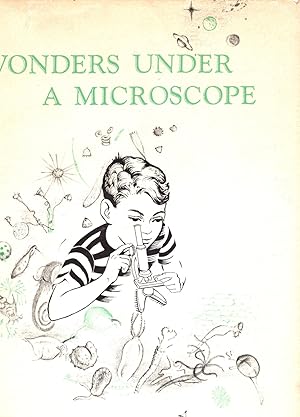
Wonders Under a Microscope
Language: English
Published by Dodd, Mead & Company, NY, 1959
Seller: Dorley House Books, Inc., Hagerstown, MD, U.S.A.
Seller rating 4 out of 5 stars

First Edition
Hardcover. Condition: Very Good. Dust Jacket Condition: Very Good. Author Illus (illustrator). 1st. First Edition, First Printing; dj w/unclipped price, in mylar;; ownr's insc on flyeaf; deluxe binding; 62 clean, unmarked pages/index.
-

Hardback. Condition: Good. 1st edition. Wonders Through The Microscope by Editorial Staff of Popular Science. Published by Popular Science Publishing Co, New York, NY, 1934. 1st Edition. Hardbound. No DJ. Size 12mo (up to 7-1/2'' tall). Condition: Good. Wear to edges, cloth covering spine broken & torn, needs repair. Title & pg 191 split at spine. Overall content excellent. 192 Pgs. Part of the Handyman's Modern Manuals series. A complete manual for amateurs. How to use equipment, secure and preserve specimens, take photomicrographs, etc. Illustrated. Description text copyright 2007 BooksForComfort. Item ID 14466. book.
-
Dialogues on the Microscope, Intended for the Instruction and Entertainment of Young Persons, Desirous of Investigating the Wonders of the Minuter Parts of Creation: containing an account of the principles of vision; and of the construction and management of the most improved and generally useful microscopes; with their application to the discoveries made by them in the different kingdoms of the natural world; in Two Volumes, Volume One only
Published by J. Johnson and Co., London, 1812
First Edition
Half-Leather. Condition: Good+. No Jacket. First Edition. Small half-leather hardcover with green-gray spine with gilt lettering; marbled boards; 232 pages; 7 b&w plates at end; 1812 on title page is the only date. Good plus condition: mild wear and a little scuffing to binding; straight; hinges cracked inside but holding very well; old bookplate of one Thomas Buchanan Esq., Powis; pages are quite nice albeit not perfect. Size: 24mo - over 5 - 5¾" tall. Book.
-
The Wonders of Plant Life: Under the microscope
Language: English
Published by G. P. Putnam's Sons, 1883
First Edition
US$ 102.26
US$ 17.44 shipping
Ships from United Kingdom to U.S.A.Quantity: 1 available
Add to basketHardcover. Condition: Very Good+. 1st Edition. Red-brown cloth boards with gilt spine titles, decorative gilt cover titles and gilt image of microscope with black floral decoration; floral endpapers. Slight wear to extremities, slight darkening of spine, library sticker to spine; gilt titles and decoration remain bright. Contents remain very crisp and clean with light age toning. Girard College Library sticker to FEP with stamp to title page. Name in pencil to title page. Black and white line drawings throughout. A lovely copy of the true 1st edition.
-
[Juvenile] The Wonders of the Telescope. By the Author of "The Wonders of the Microscope"
Published by William Darton & Son, Holborn Hill, London, 1830
Seller: Fine Editions Ltd, Willow Street, PA, U.S.A.
Association Member: IOBA
Seller rating 5 out of 5 stars

First Edition
Quarter Sheep. Condition: Near Fine+. Scarce early edition of this beautifully illustrated children's book. 12mo (144 x 89 mm): iv,5-156pp, with folding engraved frontispiece of the solar system and 13 further plates, most folding and all but two dated 1823. Of special note is the plate of Herschel's 40-foot telescope, constructed between 1785 and 1789 and shortly to be dismantled, in 1839. Original red quarter skiver, spine lettered longitudinally in gilt, marbled paper-covered boards. Neat gift inscription (dated 1898) to front fly leaf; recent book label of Stanley Scott, Chard, Somerset, to rear paste-down. Professionally refurbished and now presenting attractively: two closed tears to frontispiece skillfully mended with Japanese tissue, else tightly bound, with pages and plates remarkably fresh and bright. Darton H1605(2). Paul, Children's Book Business: Lessons from the Long Eighteenth Century. Osborne, p. 216 (for first edition). First published in 1805 and again in 1809, here issued by Quaker publisher William Darton. Sir Richard Phillips, a friend of Priestley and a fascinating figure in the Regency world of letters, published the first edition, and he may have been the author: Phillips founded a philosophical society whose activates included astronomical observations. The Wonders of the Telescope was recommended by educator Eliza Fenwick in her Visits to the Juvenile Library (1805), where it is described, on a visit to Tabart's bookshop, as "two [the other was The Wonders of the Microscope] of the most popular books in the shop" (cited in Paul, p. 91). N. B. With few exceptions (always identified), we only stock books in exceptional condition, carefully preserved in archival, removable mylar sleeves. All orders are packaged with care and posted promptly. Satisfaction guaranteed. (Fine Editions Ltd is a member of the Independent Online Booksellers Association, and we subscribe to its codes of ethics.).
-
The Wonders That Await a Micro-Microscope, pp. 45-47 in: Saturday Review, 2 April 1960. THE BIRTH OF NANOTECHNOLOGY
Publication Date: 1960
Seller: Landmarks of Science Books, Richmond, United Kingdom
Seller rating 4 out of 5 stars
First Edition
US$ 1,036.41
US$ 40.25 shipping
Ships from United Kingdom to U.S.A.Quantity: 1 available
Add to basketSoft cover. Condition: Very Good. 1st Edition. First edition, journal issue in original printed wrappers, of the earliest practically obtainable printing of Feynman's famous and visionary Caltech after-dinner lecture, 'There's plenty of room at the bottom,' which represents the birth of nanotechnology, the field of applied science involving manipulating matter on an atomic and molecular scale. "The revolutionary Feynman vision . . . launched the global nanotechnology race" (Drexler, p. 21). At the annual meeting of the American Physical Society in December 1959, Richard Feynman delivered an after-dinner lecture entitled 'There's Plenty of Room at the Bottom'. "The banquet speech would prove prescient. Feynman's lecture is widely accepted as spurring the field of nanotechnology, and the Nobel Prize Committee lauded it as visionary when they awarded the 2016 Nobel Prize in Chemistry to researchers who assembled tiny motors made of molecules" (Kornei). Years before the term nanotechnology would be coined, Feynman laid out the principal problems and potentials of the field. He noted, "I will not discuss how we are going to do it, but only that it is possible in principle in other words what is possible according to the laws of physics." Feynman considered the possibility of direct manipulation of individual atoms as a more powerful form of synthetic chemistry than those used at the time. Feynman laid out challenge after challenge: reducing the Encyclopedia Britannica to a pinhead, making an electron microscope that could see individual atoms, building a microscopic computer, and even "swallowing the doctor": building a tiny, ingestible surgical robot. In an era when computers filled entire rooms, what Feynman proposed seemed nearly unfathomable: "I am not afraid to consider the final question as to whether, ultimately in the great future we can arrange atoms the way we want; all the way down!" A transcript of 'Plenty of room' was published by the Caltech magazine Engineering & Science in February 1960; this is very rare indeed (we are not aware of any copy of the journal having appeared on the market). The present article is the earliest reprint of the Engineering & Science article, and is virtually identical to it except for the omission of the first two introductory paragraphs, and the final three, in which Feynman proposes a prize for the first person who can reduce a page of a book to 1/25,000 of the original size in such a way that it can be read by an electron microscope. Drexler, 'Nanotechnology: From Feynman to Funding,' Bulletin of Science, Technology & Society 24 (2004), pp. 21-27. Kornei, 'The Beginning of Nanotechnology at the 1959 APS Meeting,' APS News, November 2016. 8vo, original printed wrappers (wrappers very slightly creased and soiled, address label on front wrapper, pages lightly browned). A very good copy.


![Seller image for [Juvenile] The Wonders of the Telescope. By the Author of "The Wonders of the Microscope" for sale by Fine Editions Ltd](https://pictures.abebooks.com/inventory/md/md31456621494.jpg)
