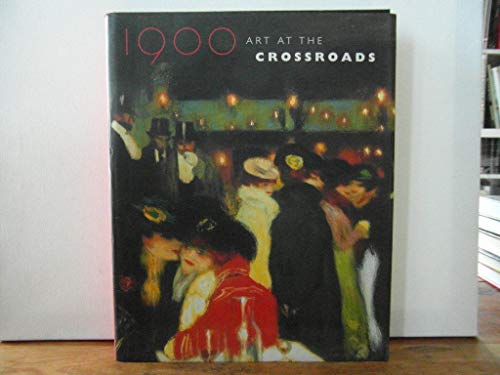
Exactly 100 years ago, art was at a crossroads. Painters such as Sargent, Whistler, Homer, and Rouault were widely acclaimed. Czanne, Degas, Gauguin, Toulouse-Lautrec, Rodin, Munch, Klimt, and other modern masters were in their prime. And the revolutionaries who would go on to change the course of Western art-Picasso, Matisse, Mondrian, Kandinsky, and Nolde, among others-were just getting started.
This book, the companion volume to a major international exhibition, provides an eye-opening look at what these and other artists were creating in this watershed year. Organized by subject-from bathers, femmes fatales, and self-portraits to rural scenes, religion, and social comment-and featuring more than 300 colorplates, the book presents both famous and less well-known works. By including a wide range of paintings and sculptures executed at roughly the same time, Robert Rosenblum and MaryAnne Stevens illuminate the cultural crosscurrents that were reshaping Western art-including nationalism, psychology, and technology-and help us see familiar masterworks with a fresh eye. More than 500 illustrations, more than 300 in full color, 9 5/8 x 12"
ROBERT ROSENBLUM is professor of fine arts at New York University, a curator at the Solomon R. Guggenheim Museum in New York City, and a contributing editor at ArtForum. His 14 previous books include such classics as Abrams' Cubism and 20th-Century Art and, with H. W. Janson, 19th-Century Art.
MARYANNE STEVENS is senior curator at the Royal Academy of Arts, London. She has edited and contributed to many books and catalogues, including Monet in the 20th Century and The Impressionist and the City.
An exhibition organized by The Royal Academy of Arts, London, and the Solomon R. Guggenheim Museum, New York, 1900: Art at the Crossroads examines the diverse range of artworks produced during this period. While artists such as C?zanne, Degas, Rodin, and Klimt were well known by the turn of the century, lesser-known artists were making art that equally reflected the stylistic and social concerns of this epoch. In his essay, the Guggenheim's Rosenblum explores various related themes that are woven within the paintings and sculpture. These include subjects such as fantasy vs. reality, the representation of women, and the new psychological probity. The Royal Academy's Stevens shows how the Exposition Universelle of 1900 in Paris and the issue of nationalism as well as the genesis of international styles in the art of this period foreshadowed developments and the rest of the 20th century. The catalog portion of this book is illustrated with color plates of all the works in the exhibition and divided by theme, such as the city, landscape, portraits, bathers and nudes, and religion. This handsome volume is recommended for general art collections as well as academic and art libraries.
-Sandra Rothenberg, Framingham State Coll., MA
Copyright 2000 Reed Business Information, Inc.