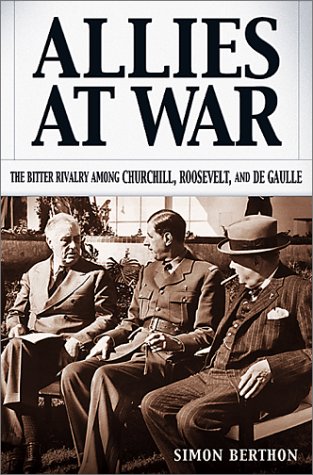
Roosevelt, Churchill, De Gaulle. They held the destiny of the Free World in their Allied hands as Nazi forces stormed through Europe in the 1940s. In public, these three extraordinarily powerful men stood firmly together against Hitler. They inspired their troops and gave their nations confidence in the prospect of victory. History has made of them giants of diplomacy and unparalleled masters of strategy. Yet, in private, their relations with each other were marked by turbulence, distrust, duplicity, and ruthlessness, as this new volume in the annals of World War II history dramatically shows. A tie-in with a joint BBC/PBS special scheduled for American television in the fall, this revelatory chronicle by Simon Berthon documents an antipathy that would significantly color Allied policy and alter the postwar relations of France with Britain and America. Throughout the war in Europe, Berthon shows, Churchill and Roosevelt stood at odds with the imposing and, to them, "unreliable, uncooperative, and disloyal" Free French leader Charles De Gaulle—to the extent that they kept the Anglo-American invasion of North Africa a secret from him and sought an alternative commander. And even as late as 1943, Roosevelt supported the oppressive and collaborative Vichy government based on misinformation fed to him about De Gaulle. Probingly, with access to official archives never before available, Berthon explores an alliance as it turns profoundly sour and shows how De Gaulle not only heroically held his ground in the cause of a Free France but ultimately implemented against the "Anglo-Saxon powers" his own revenge.
Berthon's narrative accompanies his forthcoming PBS telecast about Charles de Gaulle's struggles once France fell to the Nazis in 1940 to play the modern Joan of Arc. Aged 49 and a one-star general for only three weeks, he had flown to London five days before Paris was surrendered. Legally, Marshal P‚tain's collaborationist regime at Vichy represented France, but de Gaulle almost singlehandedly established the exile "Free French" to continue the war from England and some of the colonies. In Berthon's view, de Gaulle had four enemies Germany, Vichy, a skeptical Churchill and a hostile Roosevelt. This hostility, fed by at best half-truths from Roosevelt's rightist links to P‚tain ambassador Admiral Leahy, State Department adviser Charles Murphy and Secretary of State Cordell Hull more than by Churchill, shackled and even undermined de Gaulle. Berthon describes vividly the wartime climate of duplicity and distrust: Churchill tried to "straddle the two Frances"; de Gaulle compensated for his powerlessness with haughty pride; Roosevelt (for whom "France had lost all right to...respect by her abject failure in 1940") excluded de Gaulle from all decisions affecting France. Relations worsened in victory, when the French embraced de Gaulle and reality forced British/U.S. recognition of his legitimacy. In Berthon's opinion, Churchill equivocated, and U.S. players were villainous. Though he makes little of de Gaulle's postwar promotion of the myth of mass French resistance to fascism, his wartime de Gaulle is convincingly heroic. None of the three leaders comes off well which may give the book a controversial edge. 8 pages of b&w illus. (Oct.)Forecast: The three-part TV series is scheduled to run in 2002; in the meantime, the book is a History Book Club selection and should have broad appeal to readers of WWII titles.
Copyright 2001 Cahners Business Information, Inc.
Berthon's fascinating account of the relationship among Franklin Roosevelt, Winston Churchill, and Charles de Gaulle accompanies this fall's three-part BBC/PBS series Allies at War. Series producer Berthon shows that each had far from absolutely positive feelings about the others and that while the relationships changed over time, they were hardly the picture of mutual support one might expect from Allied leaders fighting the Axis. The troubled relationships stemmed from the three leaders' different politics, goals, and personalities. The fall of France produced the rise of Charles de Gaulle, whom FDR never took seriously until the very end of the war. Churchill, who initially admired de Gaulle, was trapped by his dependence on FDR into undermining the French. Churchill is presented as a source of good advice, but FDR often received far from good advice. In some ways, de Gaulle emerges indirectly as the hero of this story despite his many personality flaws. Though this is not a new story, and the absence of footnotes may bother scholars, it is nonetheless a readable and captivating glimpse into the personalities and goals of the three Allied giants. Recommended for public libraries. William D. Pederson, Louisiana State Univ., Shreveport
Copyright 2001 Reed Business Information, Inc.
During the Vietnam War, de Gaulle was the "ally" that Americans loved to hate, because he seemed arrogant, duplicitous, and reflexingly hostile to "Anglo-Saxons." In the view of Berthon, an Englishman of French ancestry, the roots of this hostility can be traced to the friction within the Anglo-American Free-French alliance during World War II. Using previously unavailable source material, Berthon reveals a cauldron of seething jealousies, mean-spiritedness, and incredible pettiness. Roosevelt simply detested de Gaulle, and his personal dislike frequently overwhelmed his better judgment. Churchill, although no fan of de Gaulle, was inclined to pragmatically work with him; yet he often felt pressured to side with "senior partner" Roosevelt, despite his inclination to play peacemaker. De Gaulle is seen here as vain and irascible but admirably resolute in defending French honor and national interests. This book, which is a companion to a PBS-BBC documentary series scheduled for this fall, is a valuable reminder that even great statesmen can occasionally act according to foolish whims and pride.
Jay FreemanCopyright © American Library Association. All rights reserved