About this Item
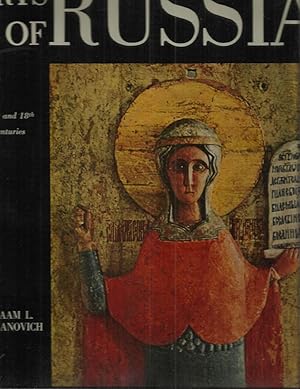
large grey gilt lettered cloth hardbound folio 2º ~ very large ("coffee table" book), international or priority shipping will cost extra. dustwrapper in protective plastic book jacket cover. fine cond. binding square & tight. covers clean. edges clean. contents free of markings. dustwrapper in fine cond. 1cm tear on rear, not price clipped. nice clean copy. no library markings or store stamps, no stickers or bookplates, no names, no inking , no underlining, no remainder markings etc ~. first edition. first printing (NAP). ~ Please Note: book is larger than scanner so the photos are a bit cropped. 173p. publisher's control note laid in. 92 color plates (many tipped~in). 31 b&w photos. many full page plates. list of illustrations. russian art. art history. russian history. history of christianity. christian art. history of architecture. russian architecture. ~ The first volume in this series, Arts of Russia: From The Origins to the End of the 16th century, showed Russian art gradually freeing itself from Byzantine influence and achieving its own distinctive aesthetic personality. In this second volume, devoted to the 17th and 18th centuries, we see the art of Russia coming into fruitful contact with the art of western Europe. The 17th century was still rooted in the artistic traditions of an earlier period, and the need to conform to the canons laid down by Patriarch Nikon left little scope for creative exuberance. This was the period that saw the emergence of such centres of artistic life as Rostov and Yaroslavl. The 18th century, in contrast, turned deliberately towards the West. Peter the Great created a splendid palace at Peterhof, a Russian counterpart to Louis XIV's Versailles. Italian and French architects~Rastrelli, Rinaldi, Quarenghi, Vallin de la Mothe and others designed the great buildings erected during this period: the Winter Palace, Tsarskoe Selo, Smolny Convent, the Academy of Arts, the Little Hermitage, and many more. In these years Russia enjoyed a splendid flowering of baroque architecture. Western influence is evident also in the field of painting. This is perhaps hardly surprising in view of the considerable number of French artists who were brought in to teach at the Academy of Arts after its foundation in 1758. Nor is it surprising that certain paintings by such artists as Levitsky, Borovikovsky, Ivan Nikitin, Vishnyakov and Shubin can be taken for works by Greuze, Madame Vigee~Lebrun or Hubert Robert. This contact with the West, too, led to the process of secularisation which is one of the most striking features of Russian art in this period. This brilliant and fascinating study by Abraam Kaganovich, of the Department of Russian Art in the Academy of Arts of the Soviet Union, opens up entirely new horizons for the western reader.
Seller Inventory # 10311603
Contact seller
Report this item