Synopsis
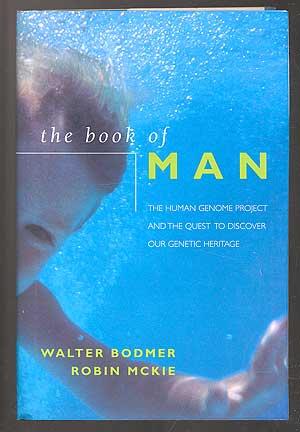
A history and analysis of the Human Genome Project--also known as The Book of Man--the massive international effort mapping each of the three billion molecules that make up human DNA, chronicles the progress of the undertaking. 15,000 first printing.
Reviews
Rather than focusing on the politics and intrigue behind the Human Genome Project (HGP), this exciting, valuable primer emphasizes the scientific breakthroughs and remaining hurdles facing the international cooperative effort to map the three million genes that comprise human DNA. Bodmer, a British geneticist and former president of the Human Genome Organization (which fosters global collaboration in genome mapping), and Observer science correspondent McKie believe the HGP will provide information vital to the treatment of diseases, understanding of individual differences in behavior and human evolution and the development of new pharmaceutical drugs. Inherited illnesses, such as cystic fibrosis and Huntington's chorea, are beginning to yield to molecular genetics, and the authors also show how ongoing research is raising the prospects for effective treatment of cancer, diabetes and Alzheimer's disease. They conclude with a levelheaded look at the ethical issues surrounding genetic testing and gene theory, in which missing genes are inserted into people afflicted by inherited ailments. A tour de force of popular exposition. Illustrated.
Copyright 1994 Reed Business Information, Inc.
As a former president of the Human Genome Organization, an international effort aimed at mapping the three billion molecules that make up the human DNA, Bodmer is eminently qualified to write on the subject of genetics and the Human Genome Project. He and science writer McKie have done a superb job of making extremely technical genetic and molecular processes understandable to the lay reader. Their book contains exhaustive information on how human genes are mapped and why this mapping is important in medical, evolutionary, and sociological terms. A particularly interesting chapter discusses the process of genetic fingerprinting and its use in criminology. While the authors discuss the project in its broadest context, Tom Wilkie's Perilous Knowledge (Univ. of California Pr., 1993) is equally readable and a better choice for an in-depth discussion of the history, politics, and ethical implications of the project. Bodmer's work is nevertheless a valuable addition, particularly for public libraries and large general science collections.
Tina Neville, Univ. of South Florida Lib., St. Petersburg
Copyright 1994 Reed Business Information, Inc.
Bodmer, a distinguished British geneticist, and McKie, a science reporter for the Observer, have written an engaging and surprisingly dramatic history of genetics. They characterize the Human Genome Project as a great quest that will achieve nothing less than "a new understanding of what it means to be a human being." Right from the start, they address the fears many of us have about genetic engineering. While proof of the inheritance of physical characteristics and diseases intrigues us and gives us hope, evidence supporting the genetic basis of certain personality traits frightens us: we're afraid that our uniqueness as individuals is being questioned and somehow threatened. Such worries are quickly dispelled as Bodmer and McKie trace the development of genetics from Gregor Mendel's work with plants in the early nineteenth century to Crick and Watson's breakthrough discovery of DNA, and today's genetic testing. They stress the benefits of understanding the complex language of genes as they describe the search for the causes of such terrible illnesses as Huntington's chorea and various mental disorders. Increased genetic knowledge will also enhance our understanding of our evolutionary past, and, if key ethical issues are resolved, will ensure a healthier future. Donna Seaman
"About this title" may belong to another edition of this title.