Synopsis
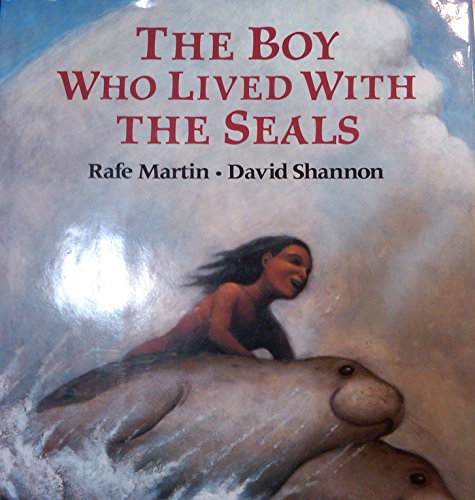
In a traditional story from the Chinook people of the Northwest, a young boy disappears and is found years later, swimming with the seals.
Reviews
Grade 1-4-- When a young boy fails to return to his People's camp after playing by the River, his parents search for him, never abandoning hope. Another spring brings a sighting of a boy among the wild seals at the River's mouth, and he is captured and returned to the People. His parents patiently re-educate him in human ways, but although he acquires near-magical skill in making beautiful carvings and useful bows and arrows, his memories of life with the seals alienate him from humans. One day he rejoins the seals, asking his mother and father not to grieve. Their response is to put the box of his carving tools into the River; in return, he leaves them a new canoe every spring, each one more beautifully carved than the last. An expanded version of a Chinook legend, this story recalls European animal-bride and Asian crane-wife tales, but the shift from adult female to child protagonist alters its impact in ways that make it especially appropriate for children. The tale acknowledges the child's individuation, while depicting parents whose love for their offspring is beyond doubt, but who accept both his differentness and, ultimately, his need for separation. The powerful restraint of the narrative, with its understated themes of love, loss, and the immortal gift of art, is balanced by the down-to-earth, expressively stylized realism of the acrylic paintings. This title convincingly suggests the distinctive look of the Northwest Coast peoples and their art. Martin conveys as well the parents' deep concern, the anguish of the boy when he feels displaced, and his exuberant joy with the seals. This is an exceptionally fine addition to the growing shelf of Native American lore. --Patricia Dooley, University of Washington, Seattle
Copyright 1993 Reed Business Information, Inc.
In this bittersweet story developed from a Chinook legend, an Indian boy wanders off from his parents as they are camped along a riverbank--"The whole tribe began searching. But there were no traces of the boy." The lad dwells among seals for a time; indeed he becomes one of them, for "he wouldn't talk, but only grunted and barked like a seal." Brought back to his people, he gradually resumes his human traits, and begins to carve canoes, paddles and weapons for his people, all adorned with fantastical "designs of the sea and the sea's creatures." But the youth cannot escape the water's pull: he returns to his marine existence, each year leaving a beautiful canoe for his grieving parents. This second collaboration by the creators of The Rough-Face Girl exhibits many of that work's notable characteristics. Once again Shannon's dark, romantic paintings are dramatically stylized; many of his individual images display a similarly haunting quality. Martin's retelling employs lyrical language while carefully retaining a clarity appropriate for the intended audience. Another potent Native American offering from a gifted pair. Ages 4-8.
Copyright 1993 Reed Business Information, Inc.
In the heroic style of Martin and Shannon's The Rough-Face Girl (1992), a fairly elaborate expansion of ``a very short story told by the Chinook people of the Northwest Coast.'' A little boy playing by the water disappears; his grieving parents don't see him again until, years later, after a woman from another tribe espies him among the seals. Captured, the seal-like boy reluctantly tries to adapt, meanwhile learning to carve exquisitely decorated canoes. Then he escapes once again to the seals; but each year his parents find, as a gift, a beautiful new canoe. Martin's extended text has the yearning, bittersweet tone of tales like the selkie stories, where a character is torn between two worlds. In Shannon's carefully composed paintings, the nobly dignified ``People'' are set against backgrounds celebrating the austere beauty of forest and sea. A handsome setting for a satisfyingly dramatic tale. (Folklore/Picture book. 5-10) -- Copyright ©1993, Kirkus Associates, LP. All rights reserved.
"About this title" may belong to another edition of this title.