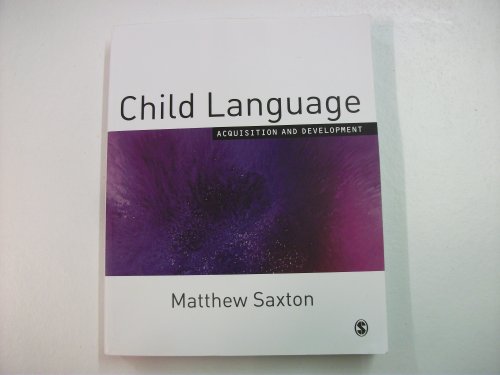
The acquisition of language is a staggering feat, yet one that all typically developing children manage by the time they reach school age. Child Language: Acquisition and Development presents the latest thinking and research on how children acquire or develop their first language, written and developed in a manner that will be stimulating and interesting for a range of undergraduate students.
The reader is taken from a standing start to the point where they can engage with key debates and current research in the field of child language. No background knowledge of linguistic theory is assumed and all specialist terms are introduced in clear, non-technical language. A theme running through the book is the nature-nurture debate, rekindled in the modern era by Noam Chomsky, with his belief that the form language takes in the child is largely determined by genetic factors. This book is rare in its balanced presentation of evidence from both sides of the nature-nurture divide; in effect, it uniquely presents a case for language acquisition and development.
The reader is encouraged to adopt a critical stance throughout and weigh the evidence for themselves. Key features for the student include:
- boxes and exercises to foster an understanding of key concepts in language and linguistics;
- a glossary of key terms; suggestions for further reading;
- a list of useful websites at the end of each chapter;
- discussion points for use in class;
- and separate author and subject indexes.
Child Language: Acquisition and Development is an indispensable textbook for undergraduate students in Psychology, Linguistics, Education and Childhood studies.
Matthew Saxton is trained in psychology and linguistics at the Universities of Edinburgh and Oxford, and worked for about 20 years variously at Royal Holloway, University of London, Westminster University and the Institute of Education - UCL. In 2011, he retrained as a nurse and now works in the NHS at a central London hospital.