Synopsis
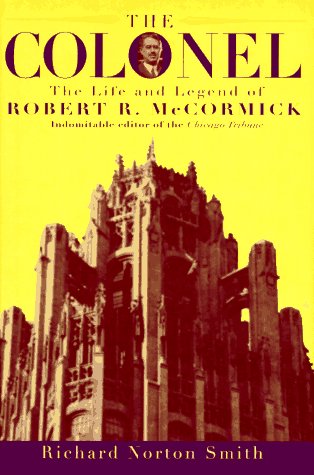
For most of his varied and colorful career, Colonel Robert R. McCormick was the self-proclaimed emperor of "Chicagoland," a Middle America of his own imagination, forever at odds with the alien East and the flaky West. From the 1920s through the mid-1950s, he was editor and owner of the Chicago Tribune, a joyously combative conservative broadsheet that under his leadership grew to become the most widely read full-size daily in the United States. To admirers he was the scourge of bleeding-heart liberals, an emblem of the Old Order in the age of the New Deal. To detractors he was a half-crazed demagogue whose personal exploitation of a powerful news medium was a flagrant abuse of the public trust. In fact, he was all this -- and more. Published to coincide with the 150th anniversary of the Tribune, The Colonel is the first biography to draw on McCormick's personal papers. Richard Norton Smith has written a vivid, candid, sympathetic life of an American original, a lifelong controversialist whose outspoken views, for better and for worse, shaped the political temper of his times. "I was determined to lead a great life, an exotic life," McCormick wrote, and for once he was guilty of understatement. Patterning himself on his grandfather Joseph Medill, he found fame as a municipal reformer, cleaning up Chicago's water supply. During World War I, he was the sole American correspondent to accompany the Russian Army; later, as an officer of the U.S. First Division, he fought with distinction in the Battle of Cantigny. He was a strident isolationist whose hobby was military strategy, an implacable anglophobe who adored a good fox hunt, a finger-pointing moralist whose private life bordered on the scandalous. As owner-editor of the Tribune, he was a ruthless competitor, yet he was also a First Amendment absolutist who effectively, even heroically, defended the press from government coercion. At the height of his power, he oversaw an empire whose holdings included not only the Tribune but also the New York Daily News, the Washington Times-Herald, a large chunk of Canada, and "the most beautiful office building in the world," Chicago's Tribune Tower. Richard Norton Smith tells McCormick's story with humor, verve, and an eagle eye for revealing detail. Here is McCormick exposing the fiscal crimes of Mayor "Big Bill" Thompson, investigating the gangland murder of a corrupt reporter, and holding Henry Ford up to ridicule in "the trial of the century." Here is McCormick at his most indomitable, at war with his nemesis, FDR, who sought unsuccessfully to indict him for treason. The Colonel is a story by turns amazing, amusing, and appalling. As Smith remarks of McCormick's Tribune, it will provoke its readers "to spasms of outrage punctuated by laughter."
Reviews
The epic story of the the contentious publisher and fervent conservative who, along with William Randolph Hearst, was a model for Orson Welles's Citizen Kane. In its heyday, writes Smith (Patriarch, 1993, etc.), there was no paper quite like the Chicago Tribune, the self-proclaimed World's Greatest Newspaper, and McCormick, its editor and publisher, made himself synonymous with the Windy City. At once acerbic and empathetic, the multifaceted Colonel lived many lives- -city official, soldier, inventor, historian, and publisher--but, Smith observes, it is as the begetter of controversies that he is best remembered. McCormick, who joined the Tribune as treasurer after working as president of the Chicago Sanitary District, picked up where his contentious predecessor, maternal grandfather, and early Tribune editor Joseph Medill, left off. Serving in France in 1917, Bert McCormick was promoted to lieutenant colonel and saw heavy action. Returned stateside and established in his sanctum on the 24th floor of the new Tribune Tower, he found in Hoover and Prohibition (and, later, the New Deal Democrats) confirmation of his worst fear: ``an overreaching government enacting laws that resulted in unprecedented lawlessness.'' McCormick's Tribune, a bible to hundreds of small-town editorial writers, waged ceaseless battle with the Colonel's Groton classmate FDR, courting White House ire with revelations of US military plans on the eve of Pearl Harbor and later coming within a hairsbreadth of an espionage indictment over reporting on the Battle of Midway. Consumed with concerns over labor and succession at the Tribune, McCormick spent his final years ``marooned,'' like Kane, a man out of his time. Smith, the first biographer with access to the Colonel's private papers, orchestrates, with an objective eye for ironic detail and a firm grasp of events and their significance, a vivid ensemble of characters on a domestic and international stage. An indispensable guide to an outsize character and his era. (16 pages b&w photos, not seen) -- Copyright ©1997, Kirkus Associates, LP. All rights reserved.
McCormick ruled the roost at the Chicago Tribune for 30 years. Thoroughly using his unlimited access to all of Robert McCormick's personal and corporate papers, Smith portrays a man of eccentric genius and stunning contradictions, who was at once an ardent patriot and a "prototype reactionary," a visionary and an anachronism, a soldier who revered martial virtue while despising martial force. This publication of the first full-scale biography of the patriarch of the "World's Greatest Newspaper" is both balanced and respectful. The sometime foil of contemporaries Randolph Hearst, Joseph Pulitzer, Henry Ford, and Marshall Field, Colonel McCormick ran his newspaper like an army camp and saw politics as another brand of war. Whether fighting at Cantigny or the White House, whether brilliant or unhinged, the colonel was a fascinating, spontaneously generous, gossip-loving, hard-core conservative whose army-division and newspaper employees were surrogate family. Ironically, the admittedly phobic titan who drove around Chicago in a khaki-colored Rolls Royce most feared being forgotten. Smith's terrific, broad-shouldered book almost guarantees that his fear will never be realized. Patricia Hassler
Robert R. McCormick, longtime owner and editor of the Chicago Tribune during the first half of this century, makes today's media barons seem bland. The likes of Ted Turner and Rupert Murdoch could learn a thing or two from this colorful and witty biography by an accomplished biographer/historian and director of the Gerald R. Ford Museum and Library. One of McCormick's prep school classmates at Groton was Franklin D. Roosevelt, who was to remain a lifelong rival. The characters here represent a crosssection of early 20th-century Americana, including McCormick's newspaper nemesis, William Randolph Hearst (see W.A. Swanberg's Citizen Hearst, LJ 8/61), Henry Ford, and Al Capone. Some of the best moments in the book are Smith's descriptions of Chicago at the turn of the century, when the term newspaper wars could be taken literally. Highly recommended for journalism and Chicago history collections.?Bruce D. Rosenstein, USA Today Lib., Arlington, Va.
Copyright 1997 Reed Business Information, Inc.
"About this title" may belong to another edition of this title.