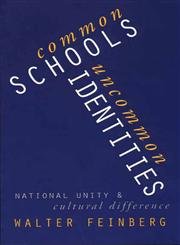
How can we resolve the debates between groups such as blacks, Latinos, gays, and women who demand that school curricula recognize their particular identities and others who insist that public education should infuse children with a common American identity? Educational philosopher Walter Feinberg here takes on the debate and suggests ways to promote both cultural and national identities.
"Feinberg`s book addresses the most urgent questions about the future of American education, and everyone who cares about that future should read it."--Callan Eamonn, professor of educational policy studies, University of Alberta
"What distinguishes this book is its quiet tone of reason and its careful effort to spell out a principled basis for rethinking public schools in a multicultural society."--David Labaree, author of How to Succeed in School Without Really Learning
.
How far should public schools go toward promoting a certain cultural group? Should negative aspects be left out so that children of a certain culture can feel good about themselves? And how can schools instruct students about other cultures and value systems without stepping on parents' toes? These are some of the questions philosophy of education professor Feinberg (On Higher Ground: Education and the Case for Affirmative Action, Teacher's Coll., 1997) tries to answer. He discusses the differences between pluralism and multiculturalism and advocates "an inclusive national identity" that addresses the concerns of both the pluralist and the multiculturalist. He feels the function of the "common school" is to teach students how to think for themselves while respecting the ideas and practices of other cultures. Feinberg's arguments are sound and should be given thoughtful consideration. Recommended for academic libraries, larger public libraries, or those with an emphasis on education.?Terry A. Christner, Hutchinson P.L., KS
Copyright 1998 Reed Business Information, Inc.