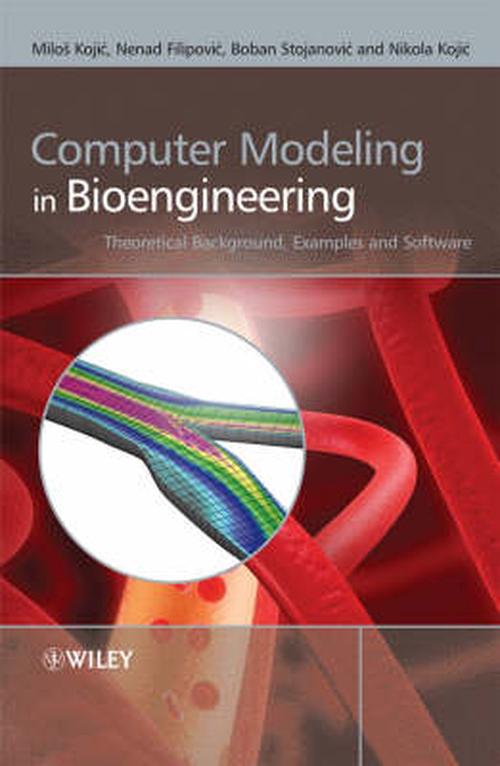
Bioengineering is a broad-based engineering discipline that applies engineering principles and design to challenges in human health and medicine, dealing with bio-molecular and molecular processes, product design, sustainability and analysis of biological systems. Applications that benefit from bioengineering include medical devices, diagnostic equipment and biocompatible materials, amongst others.
Computer Modeling in Bioengineering offers a comprehensive reference for a large number of bioengineering topics, presenting important computer modeling problems and solutions for research and medical practice. Starting with basic theory and fundamentals, the book progresses to more advanced methods and applications, allowing the reader to become familiar with different topics to the desired extent. It includes unique and original topics alongside classical computational modeling methods, and each application is structured to explain the physiological background, phenomena that are to be modeled, the computational methods used in the model, and solutions of typical cases. The accompanying software contains over 80 examples, enabling the reader to study a topic using the theory and examples, then run the software to solve the same, or similar examples, varying the model parameters within a given range in order to investigate the problem at greater depth. Tutorials also guide the user in further exploring the modeled problem; these features promote easier learning and will help lecturers with presentations.
Computer Modeling in Bioengineering includes computational methods for modelling bones, tissues, muscles, cardiovascular components, cartilage, cells and cancer nanotechnology as well as many other applications. It bridges the gap between engineering, biology and medicine, and will appeal not only to bioengineering students, lecturers and researchers, but also medical students and clinical researchers.
Milos Kojic, Senior Research Scientist, Harvard School of Public Health, Harvard University, Boston, MA
Milos Kojic is professor of mechanical engineering, University of Kragujevac, Serbia; and Senior Research Scientist, Harvard School of Public Health, Harvard University, Boston. He is one of the leading scientists in computational mechanics. He has published, as the author or mainly the first author, around 60 journal papers, among which are papers in leading international journals, as International Journal for Numerical Methods in Engineering, Computer Methods in Applied Mechanics and Engineering, Comp. Mech., International Journal of Vehicle Design, Appl. Mech., Computers and Struct, Biophysical Journal, Phys. Rev., etc. His research spans from the finite element method in general, methods of inelastic analysis of solids and structures, field and coupled problems, to biomechanics, and recently molecular dynamics and discrete particle methods.
Nenad Filipovic, Faculty of Mechanical Engineering, Serbia and Montenegro
Nenad Filipovic is associate professor of mechanical engineering, University of Kragujevac,? Serbia; and research associate at Harvard School of Public Health, Harvard University, Boston. He is young scientist and author and co-author of a number of papers in international journals.
Boban Stojanovic, University of Kragujevac, Serbia and Montenegro
Boban Stojanovic is a Ph.D. candidate in Bioengineering at Multidisciplinary Graduate Studies of University of Kragujevac. He received his B.S. at Faculty of Mechanical Engineering of University of Kragujevac, as first in his generation and most talented students. During his studies he participated significantly in development of the finite element program PAK.
Akira Tsuda, Boston, MA
Akira Tsuda is Principal Research Scientist, in the Physiology Program, Harvard School of Public Health. He is an expert in biofluid mechanics, specifically in the field of respiratory flow and aerosol physiology. He has published extensively in this field and in the related field. He has been the principal investigator of several research projects, including international bioengineering projects/p>
Nikola Kojic, Cambridge, MA, USA
Nikola Kojic is a Ph.D. candidate in the Harvard-MIT Division of Health Sciences and Technology. He received his M.S. in Mechanical Engineering in 2003 from MIT, working on synthetic and natural spider silk. Specifically, his focus was on the application of computational models to synthetic and natural spider silk fiber spinning.