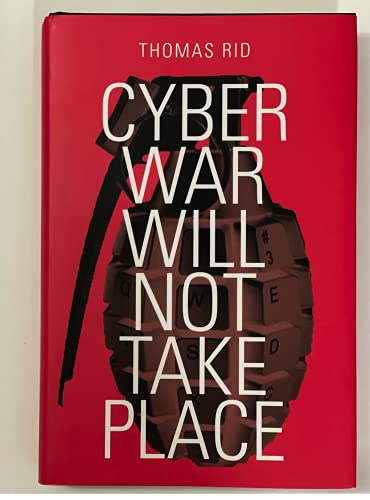
About this Item
xvi, 218, [6] pages. DJ has small creases/marks and slight soiling. Includes Preface, Acknowledgments, The Argument, Notes, Bibliography, and Index. Chapters cover What is Cyber War?; Violence; Cyber Weapons; Sabotage; Espionage; Subversion; Attribution; and Beyond Cyber War. Thomas Rid (born 1975 in Aach, Baden-Württemberg, Germany) is a political scientist best known for his work on the history and risks of information technology in conflict. He is Professor of Strategic Studies at Johns Hopkins University's School of Advanced International Studies. Previously he was a professor of security studies in the Department of War Studies, Faculty of Social Science and Public Policy King's College in London. In October 2011 the Journal of Strategic Studies, a leading international relations journal, published his provocatively titled article, "Cyber War Will Not Take Place". The text argued that all politically motivated cyber attacks are merely sophisticated versions of sabotage, espionage, or subversion-but not war. In a review of his 2013 book with the same title, The Economist considered Rid "one of Britain's leading authorities on, and sceptics about, cyber-warfare". In 2016, Rid authored an article entitled How Russia Pulled Off the Biggest Election Hack in U.S. History and in 2020, authored a book entitled Active Measures: The Secret History of Disinformation and Political Warfare about Soviet and Russian active measures. The author argues that the focus on war and winning distracts from the real challenge of cyberspace: non-violent confrontation that may rival or even replace violence in surprising ways. With a mix of technical detail and rigorous political analysis, the book explores some key questions: What are cyber weapons? How have they changed the meaning of violence? How likely and how dangerous is crowd-sourced subversive activity? Why has there never been a lethal cyber attack against a country's critical infrastructure? How serious is the threat of "pure" cyber espionage, of exfiltrating data without infiltrating humans first? And who is most vulnerable: which countries, industries, individuals? "Cyber war is coming," announced a land-mark RAND report in 1993. In 2005, the U.S. Air Force boasted it would now fly, fight, and win in cyberspace, the "fifth domain" of warfare. This book takes stock, twenty years on: is cyber war really coming? Has war indeed entered the fifth domain? Cyber War Will Not Take Place cuts through the hype and takes a fresh look at cyber security. Thomas Rid argues that the focus on war and winning distracts from the real challenge of cyberspace: non-violent confrontation that may rival or even replace violence in surprising ways. The threat consists of three different vectors: espionage, sabotage, and subversion. The author traces the most significant hacks and attacks, exploring the full spectrum of case studies from the shadowy world of computer espionage and weaponized code. With a mix of technical detail and rigorous political analysis, the book explores some key questions: What are cyber weapons? How have they changed the meaning of violence? How likely and how dangerous is crowd-sourced subversive activity? Why has there never been a lethal cyber attack against a country's critical infrastructure? How serious is the threat of "pure" cyber espionage, of exfiltrating data without infiltrating humans first? And who is most vulnerable: which countries, industries, individuals?
Seller Inventory # 81240
Contact seller
Report this item