Synopsis
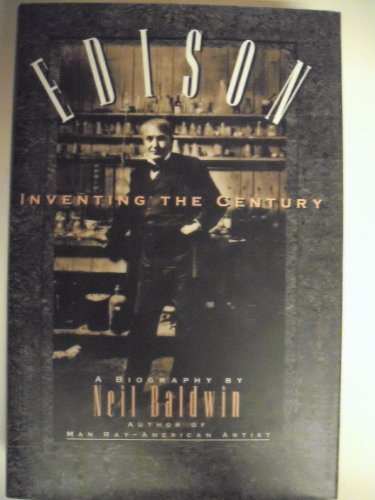
Using unprecedented access to Edison family papers and years of research at the Edison corporate archives, Neil Baldwin offers a revealing portrait of one of America's seminal inventors: a man whose imagination, dynamism, entrepreneurial brilliance epitomized the American dream as he became a victim of its darker side.
"Baldwin has demythologized the man and left the genius bigger than life." --Newsweek
Reviews
Thomas Alva Edison (1847-1931), who introduced the light bulb and the phonograph to a startled world from his pastoral New Jersey retreat, strides across Baldwin's engrossing epic biography as a complex, contradictory figure. The hearing-impaired inventor was a visionary inclined "to think globally long before achieving success locally," a cranky, authoritarian businessman, a daredevil entrepreneur pathologically addicted to work, a metaphysical thinker who practiced automatic writing and who, inspired by Madame Helena Blavatsky's theosophical/mysticism, postulated that intelligence pervades every atom of God's creation. To Baldwin (Man Ray: American Artist), the Ohio-born genius, who pioneered the microphone, the motion-picture camera and the world's first central electric-light power plant, embodied the American experiment in industrial civilization and the potential of technological change. By charting Edison's relations with venture capitalists, unsung collaborators and competitors, Baldwin spins an inspirational American saga of titanic determination and protean imagination. Edison's later projects-his decade-long, abortive iron-ore milling and smelting operation, and his return to the soil, at age 80, in search of a natural source for rubber in his own herbarium-take their rightful place in the story. We also meet the torn family man whose neglect of home and hearth contributed to the death at age 29 of his chronically ill, emotionally troubled first wife, Mary Stilwell. His second wife, heiress Mina Miller, by this account became his subservient helpmeet, while his domineering, impossible-to-please ways drove his six children into convoluted patterns of dependence and alienation. Photos.
Copyright 1994 Reed Business Information, Inc.
The Wizard of Menlo Park always attracted a great deal of press and biographical attention because his inventions--the lightbulb, microphone, phonograph, moving pictures--appeared nigh miraculous. Edison himself hated the Merlin-like moniker, claiming only to have been a diligent man. Baldwin agrees he was--and reports that at 65, Thomas Alva Edison worked a 112-hour week. Domestically, Edison was not so successful. Thomas Jr. became so estranged from his celebrated father that he dropped the surname and skulked about under various aliases. And Edison cut off relations with a daughter who had married an officer in the kaiser's army. Was Edison a flawed father or titanic exemplar of self-made individualism? Baldwin eschews categorical conclusions and rather invites the curious into Edison's homes, labs, and factories where they can make their own inspection. Libraries without any Edison biography (the last, by Wyn Wachhorst, is 15 years old and o.p.) should seriously consider this one, completely researched and ably executed. Gilbert Taylor
Thomas Alva Edison, an icon to millions, was a prodigious inventor and emblem of the American entrepreneurial spirit. His impact on our century via the electric light, the phonograph, the movie, and even Portland cement truly transformed the American experience. Capturing not only the creative and inventive thrust of Edison's life but its personal aspects, Baldwin offers first-rate writing. Baldwin, author of Man Ray: American Artist (LJ 10/1/88) and executive director of the National Book Foundation, describes with care the family and business milieu Edison fostered and lived in. He also gives generous treatment to the important people in Edison's life. The story is fascinating. Highly recommended for all libraries. [For more on Baldwin and Edison, see LJ's Behind the Book interview, "Biography of an Inventive Life," on p. 116.-Ed.]-Michael D. Cramer, Virginia Polytechnic & State Univ. Libs., Blacksbur.
--Michael D. Cramer, Virginia Polytechnic & State Univ. Libs., Blacksburg
Copyright 1995 Reed Business Information, Inc.
"About this title" may belong to another edition of this title.