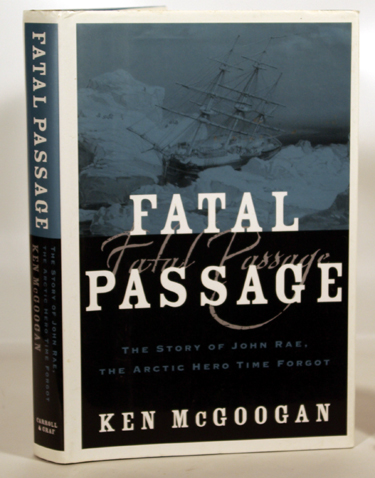
John Rae's accomplishments, surpassing all nineteenth-century Arctic explorers, were worthy of honors and international fame. No explorer even approached Rae's prolific record: 1,776 miles surveyed of uncharted territory; 6,555 miles hiked on snowshoes; and 6,700 miles navigated in small boats. Yet, he was denied fair recognition of his discoveries because he dared to utter the truth about the fate of Sir John Franklin and his crew, Rae's predecessors in the far north. Author Ken McGoogan vividly narrates the astonishing adventures of Rae, who found the last link to the Northwest Passage and uncovered the grisly truth about the cannibalism of Franklin and his crew. A bitter smear campaign by Franklin's supporters would deny Rae his knighthood and bury him in ignominy for over one hundred and fifty years. Ken McGoogan's passion to secure justice for a true North American hero in this revelatory book produces a completely original and compelling portrait that elevates Rae to his rightful place as one of history's greatest explorers.
Novelist and journalist McGoogan (Kerouac's Ghosts) combines deft storytelling with 19th-century period detail in this gripping account of "arguably the greatest Arctic explorer of the century." McGoogan shows how Rae became a Scottish hero by solving the two great mysteries of 19th-century Arctic exploration: "he discovered both the fate of the Franklin expedition and the final navigable link in the Northwest Passage, at last connecting the Atlantic and Pacific oceans across the top of North America." But the bulk of the book details how this accomplishment was unjustifiably turned against Rae. Although Sir John Franklin's earlier, 1845 attempt to find the final Northwest Passage link was "the most expensive naval expedition ever mounted" by England, it ended with the mysterious disappearance of Franklin and his entire crew. During Rae's later, successful expedition, he found proof that Franklin's crew was dead and had cannibalized their dying mates in a failed attempt to survive. When Franklin's wealthy widow, Lady Jane, began a smear campaign against Rae, she enlisted the help of Charles Dickens to write articles arguing that the Inuit "savages" who had helped Rae discover the bodies must have been the cannibals. McGoogan's extensive research reveals compelling evidence that Franklin's crew and not the Inuits were cannibals. Although Rae's accomplishments were not fully appreciated in his time, McGoogan's fascinating account should help to give Rae his rightful place in the history of Arctic explorations.
Copyright 2002 Cahners Business Information, Inc.
In 1854, John Rae of the Hudson Bay Company brought back to Britain the first tidings of the loss of the Franklin expedition. Rae's news--both ships wrecked and all 128 men lost--may not have been totally unexpected, but his claims that some of the starving men had been driven to cannibalism shocked and outraged Victorian Britain. The influential Lady Jane Franklin, angered by this stain on her husband's name, undertook to discredit and ruin Rae. Enlisting the help of politicians, navy officials, other explorers (some of them Rae's former allies), and the famous Charles Dickens, she managed to downplay Rae's other achievements, allowing others to take credit for the coastlines Rae mapped and, more importantly, the discovery of the much-sought-after final stretch of the Northwest Passage. McGoogan vehemently defends Rae and his accomplishments in this enlightening biography, and his enthusiasm is not unwarranted; Rae may truly be the most impressive and least appreciated Arctic explorer among Britain's ranks. Gavin Quinn
Copyright © American Library Association. All rights reserved