Synopsis
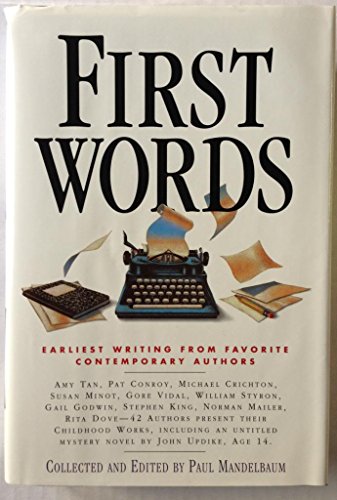
Most kids write stories. Only a few of them grow up to be successful authors. But before there was Carrie, there was "Jhonathan and the Witchs." And before there was Rabbit Angstrom, Toyota Dealer, there was Manuel Citarro, famous detective. Could we have seen the seeds of success in Stephen King's and John Updike's juvenilia?
Editor Paul Mandelbaum asked scores of authors if they - or their mothers - had saved anything they had written as children or adolescents. Forty-two writers went to their attics and dug up all manner of manuscripts - from the eight-year-old Amy Tan's essay "What the Library Means to Me," to ten-year-old Rita Dove's poem "The Rabbit with the Droopy Ear," to Norman Mailer's action-packed adventure fantasy "The Martian Invasion," also concocted at age ten.
Each of the forty-two chapters in First Words includes a brief introduction to the author, the juvenilia with commentary by writer and editor linking the childhood and adult work, photographs of the author (then and now), and, in some cases, facsimile reproductions of the original manuscripts and drawings.
The result is a funny and surprisingly informative gathering of childhood creations by today's most celebrated writers - those who are amused by and happy to share their own early efforts.
As Paul Mandelbaum says in his introduction to the book, "We pleasantly drift in and out of the knowledge that these young writers are the same people who have come to occupy the places of greatest honor on our bookshelves. Juvenilia reminds us of often forgotten truths: that art takes its nourishment from the common garden of human experience. And that authors are children grown up, still learning, even as they teach us."
Reviews
This anthology of juvenilia from 42 of America's most promising writers is valuable chiefly for the light it sheds on the wellsprings of inspiration from which many adult literary works have emerged. Mandelbaum provides a provocative introductory essay on the value of juvenilia, with notes throughout on the connections between an author's childhood writing and his or her later works. Although the reader may not always make the same connections, and although some of the excerpts, such as Vance Bourjaily's Not To Confound My Elders and John Updike's Untitled Mystery seem overly long, the commentary is knowledgeable and the selections highly original. Also, the book features photos of these current American writers, which include best-selling authors (Louis Auchincloss, Stephen King, Michael Crichton), black authors (Charles Johnson, Gloria Naylor), as well as such prominent figures as Isaac Asimov, Joyce Carol Oates, and William Styron. For general readers.
- Marie L. Lally, Alabama Sch. of Mathematics & Science, Mobile
Copyright 1993 Reed Business Information, Inc.
Forty-two writers were brave and generous enough to send Mandelbaum their childhood manuscripts. Photographs of the authors thenand now as well as facsimile reproductions of their submissions enliven this unique collection, as do Mandelbaum's pithy and engaging profiles of each author. Many writers share memories about their first forays into literature. Jill McCorkle fondly recalls her cozy little playhouse where she wrote stories that "had" to "get a laugh or a tear," while others recall how reading and writing lifted them out of the confines of childhood or profound shyness. Every submission is of interest, but some are simply hilarious, such as Margaret Atwood's satirical essay on why women should smoke cigars, and Paul Bowles' droll little dramas about love triangles, written at age 9. Precocity and sophistication beyond experience prevail. John Updike's startlingly accomplished "Untitled Mystery" was composed at age 14, while the obsessions of Michael Crichton and Stephen King were already apparent in their earliest compositions. Other contributors include Madison Smartt Bell, Gail Godwin, W. P. Kinsella, Bobbie Ann Mason, Norman Mailer, Maxine Hong Kingston, and Gore Vidal. Donna Seaman
"About this title" may belong to another edition of this title.