Synopsis
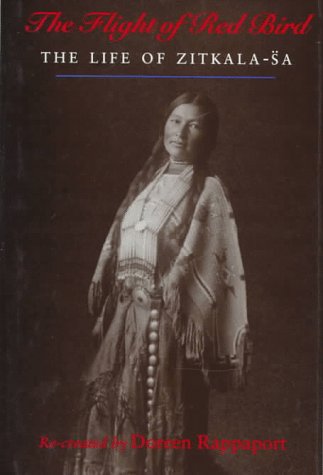
Chronicles the experiences of the Yankton Indian woman who was forced to renounce her Indian heritage
Reviews
Grade 5 Up. Gertrude Bonnin (1876-1938) was born on the Nakota, or Yankton, Sioux reservation in South Dakota. At the age of eight, she went to a Quaker boarding school in Indiana, the first of several she would attend, against her mother's wishes. Bonnin was never able to return to her life as an Indian. Relying heavily on Bonnin's own writings, letters, and diaries, as well as other primary sources and conversations with descendants, Rappaport allows her subject to speak for herself about the heartbreak, confusion, and rebellion toward her education in various boarding schools. Consequently, this account dwells most heavily on her schooling and early adult years, during which time she took the name Zitkala-Sa. Unfortunately, her later experiences as an Indian-rights activist are not given much coverage in the book; Rappaport only whets readers' appetite for additional details. The overall impression that one receives from these writings is one of loss and unhappiness, a result of the profound identity crisis that the woman felt stranded between the Indian and white worlds. This well-documented, uniquely presented book, illustrated with black-and-white photographs, should strike a chord among adolescents establishing their own identities.?Lisa Mitten, University of Pittsburgh, PA
Copyright 1997 Reed Business Information, Inc.
In this moving work, Rappaport (Tinker vs. Des Moines, 1993, etc.) adroitly recreates the life of a Native American woman born in 1876 on the Yankton Reservation in South Dakota who was forced to give up her cultural heritage and become ``civilized''--the consequence of which was her lifelong activism. At the age of eight, Gertrude left her home to attend a boarding school in Indiana; if she did not, her mother's food rations would be cut. As an adult, Gertrude wrote articles for the Atlantic Monthly describing her humiliation at how the US government tried to destroy tribal unity and traditional life and culture, signing her articles ``Zitkala-Sa,'' or Red Bird. Her letters, journals, poetry, and memoirs track the ``pain of her assimilation and her difficult journey back.'' In order to help unite Indians into a political force, Zitkala-Sa became active in the National Council of American Indians. An introduction explains how Rappaport assembled the material for her ``autobiographical biography,'' and the changes she made, based on her research. No matter how the book is categorized, readers will relish Zitkala-Sa's upholding of the warrior tradition with the ``new weapons learned from her enemy--her pen, the English language, and her organizational persistence.'' (b&w photos, chronology, glossary, sources, further reading, bibliography) (Biography. 10+) -- Copyright ©1997, Kirkus Associates, LP. All rights reserved.
Gr. 7^-10. Zitkala-Sa (Red Bird) was born Gertrude Bonnin in 1876 to a Sioux mother and a white father. At the age of eight, she left the Yankton Sioux Reservation for a boarding school in the East. When she returned six years later, she could no longer find peace on the reservation, and for the rest of her life, she lived between two cultures. She attended college, recruited students for the boarding schools she once despised, and became a well-recognized advocate and political organizer for the rights of American Indians. Rappaport draws heavily on Zitkala-Sa's writings to tell this remarkable story, and it is Red Bird's own words that bring her anguish and confusion to life. The narrative is choppy at times, but Rappaport's account of the contradictions and complex issues that Gertrude has faced in her life will have great interest for young people studying American Indians. Glossary, source notes, black-and-white photos, and an extensive bibliography. Karen Hutt
"About this title" may belong to another edition of this title.