About this Item
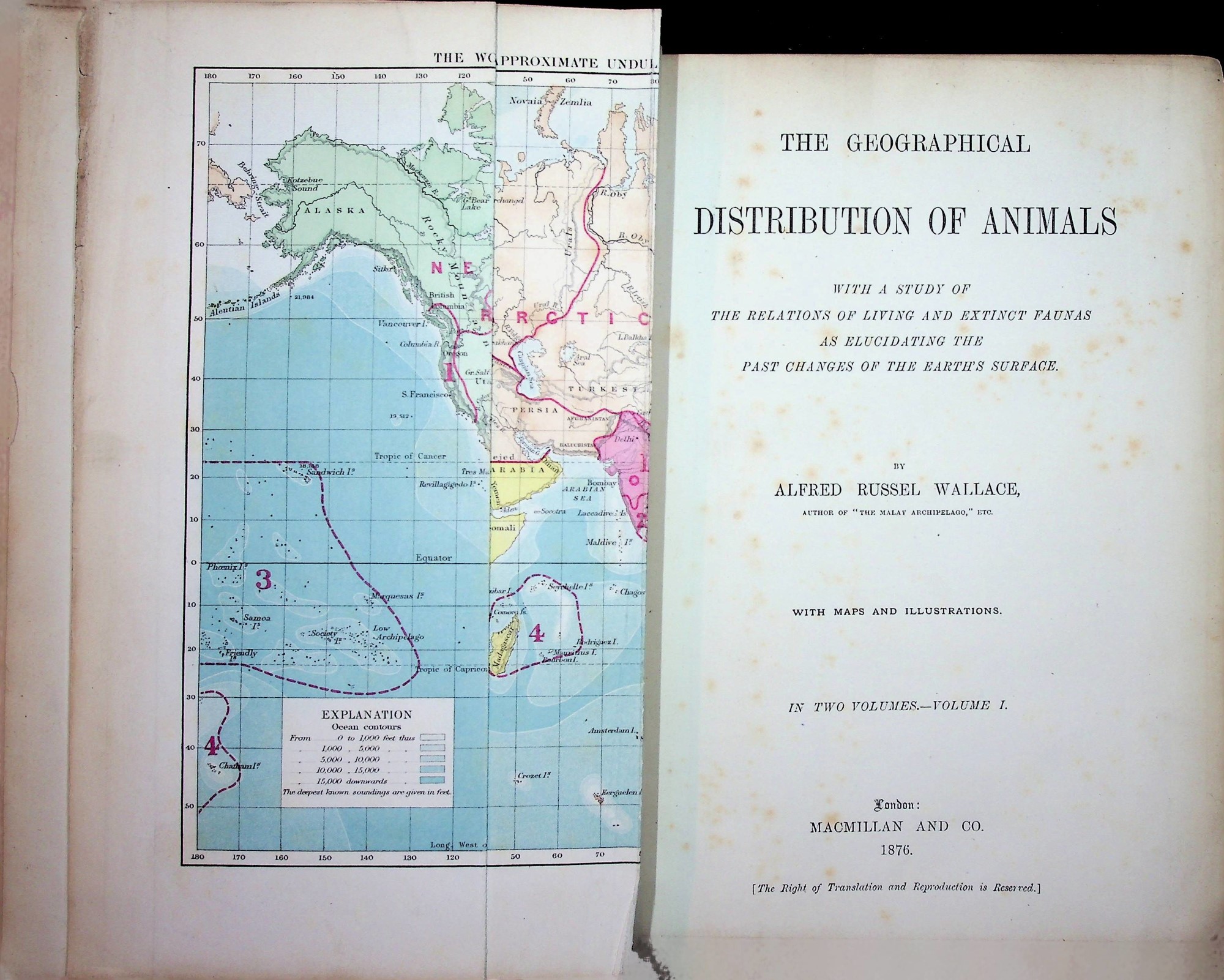
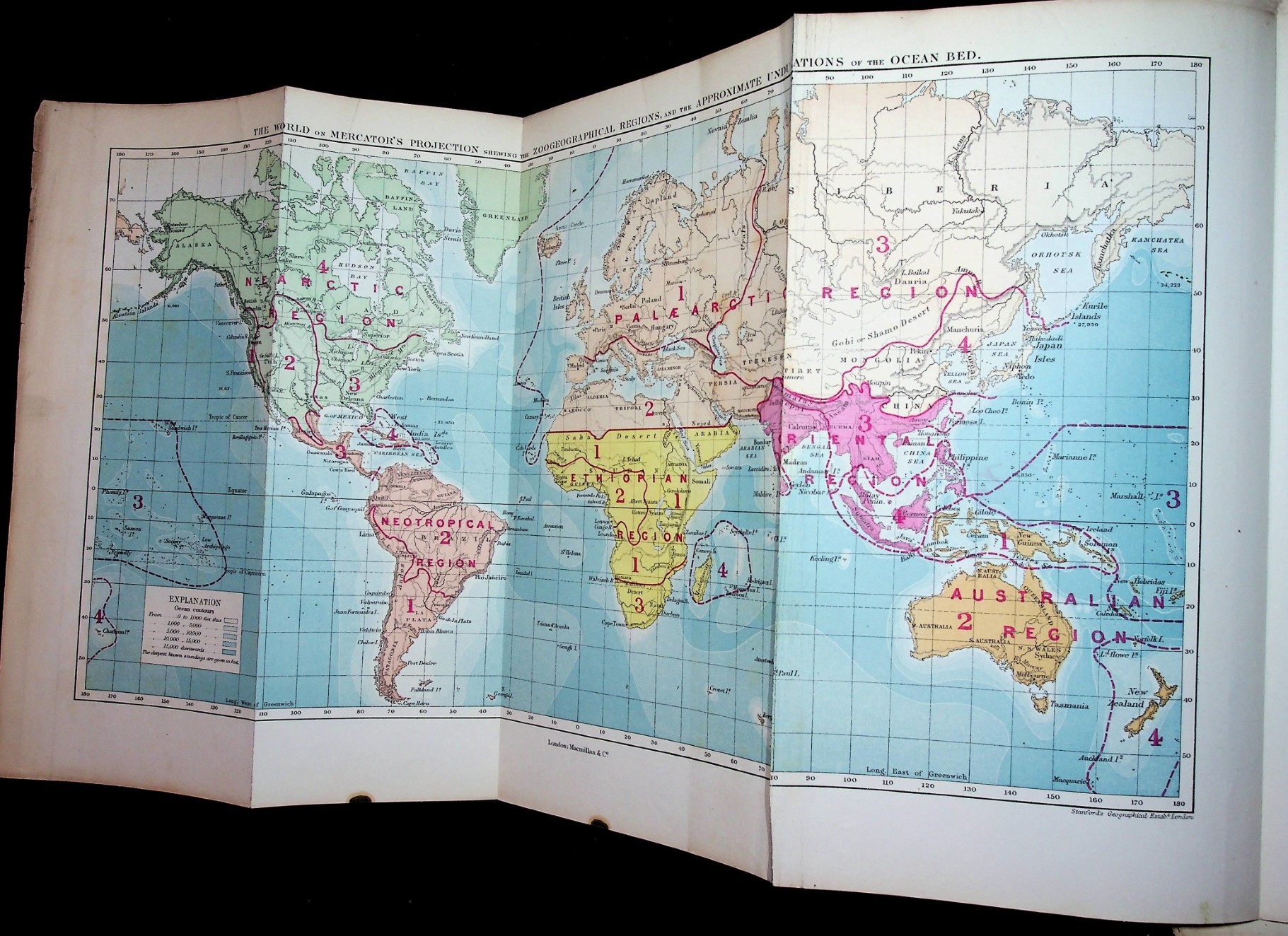
Geographical Distribution of Animals, with twenty engraved plates and seven colored maps (5 in Vol 1 and 2 in Vol 2) This is an exceptional set of this seminal work in scientific evolution Light pencil notations in margins on at least one plate London: Macmillan and Co, 1876 First Edition Two octavo volumes Original full green cloth with gilt titles and designs in excellent, sound condition, after a professionally done reinforcement of hinges for both volumes, (since these are heavy books), but all of the original binding and brown endpapers are preserved Corners are slightly bumped Slight foxing on first few and last few pages of each volume, but otherwise text is undamaged throughout Mostly unopened Near fine Provenance: Estate of Russell Johanson, Ravenna Rare Books, Seattle, Wa Ink ownership signature on FFEP's of WA Herdman, (Sir William Abbott Herdman (1858-1924) and eminent Scottish marine zoologist and oceanographer in his own right and Professor at the University of Liverpool, Fellow of the Royal Society and President of the Linnean Society Alfred Russel Wallace (1823â?"1913) was a British naturalist, explorer, geographer, anthropologist, biologist and illustrator He is best known for independently conceiving the theory of evolution through natural selection His paper on the subject was jointly published with some of Charles Darwin's writings in 1858This prompted Darwin to publish On the Origin of Species In 1872, he began research for a general review of the geographic distribution of animals Initial progress was slow, in part because classification systems for many types of animals were in flux He resumed the work in earnest in 1874 after the publication of a number of new works on classification Extending the system developed by Sclater for birdsâ?"which divided the earth into six separate geographic regions for describing species distributionâ?"to cover mammals, reptiles and insects as well, Wallace created the basis for the zoogeographic regions still in use today He discussed all of the factors then known to influence the current and past geographic distribution of animals within each geographic region These factors included the effects of the appearance and disappearance of land bridges (such as the one currently connecting North and South America) and the effects of periods of increased glaciation He provided maps showing factors, such as elevation of mountains, depths of oceans, and the character of regional vegetation, that affected the distribution of animals He also summarized all the known families and genera of the higher animals and listed their known geographic distributions The text was organized so that it would be easy for a traveler to learn what animals could be found in a particular location The resulting two-volume work, The Geographical Distribution of Animals, was published in 1876 and served as the definitive text on zoogeography for the next 80 years.
Seller Inventory # AA211
Contact seller
Report this item