Synopsis
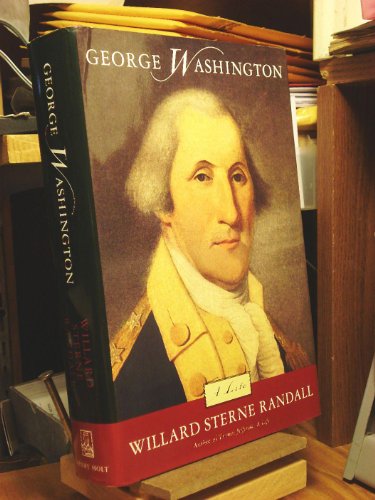
As the two hundredth anniversary of the first president's death approaches, an acclaimed biographer explores Washington's life from a personal rather than political perspective, sharing the story of his life as a man rather than a leader. 35,000 first printing.
Reviews
Biographer Randall (Thomas Jefferson, 1993) adds another compelling figure to his portrait gallery of America's early leaders. It was one of the triumphs of Washington's life that, when stymied in one of his ambitions, he found an outlet for it elsewhere. Though frustrated, for instance, in his desire to become a career British army officer because of undistinguished service in the French and Indian War (he was accused of touching off the war by killing a French officer who may have been on a diplomatic mission), he learned how to defeat the British through speed and knowledge of the terrain by witnessing firsthand the defeat of his commander, Gen. Edward Braddock. With almost half of this account devoted to Washington's pre-Revolutionary life, Randall compresses the more consequential war and early Federal years, thus sacrificing some of the drama that galvanized his biography of Benedict Arnold. On the other hand, Randall shrewdly details how Washington's dealings with hostile foes and haughty allies in the French and Indian War and his secret alliances with other patriots made him ``a master of discretion and deception.'' He provides new insight into how Washington's growing awareness of the pitfalls of Virginia's tobacco economy led to disenchantment with the British mercantile system. Most important, he finds a thread between the prewar micromanaging plantation owner and the wartime ringmaster of intelligence units and surprise engagements like Trenton, discovering ``the first modern American corporate executive.'' While displaying a more dry-eyed willingness to countenance unpleasant actions than what one expects (e.g., ordering Arnold's assassination), this Washington is also moving in his renunciations of power at the end of the revolution and at the end of his second term as president. Not the landmark in storytelling and scholarship achieved by previous Washington biographers Douglas Southall Freeman and James Thomas Flexner, but an often penetrating narrative of Washington's formative influences. -- Copyright ©1997, Kirkus Associates, LP. All rights reserved.
Randall, whose previous biographies (e.g., Benedict Arnold: Patriot, LJ 7/90; Thomas Jefferson: A Life, LJ 8/93) have enjoyed commercial success, has now joined the long list of biographers of Washington. Because the ground of the great Virginian's life has been so thoroughly plowed over the two centuries since his death, any new attempt should either bring the reader new insights into Washington's character or be so well written as to new-mint the familiar. This account does neither. Randall's writing is lively enough, but he has not rethought Washington's life in any imaginative way, preferring to write off the top of other biographies. In at least one case, his unattributed reliance on another's work borders on the extreme. In addition, there are enough careless errors that scholars will find the book unreliable. For instance, Patrick Henry did not represent Augusta County, Georgia; McGillivray's visit to New York took place well after Washington's contretemps with the Senate, not during; and at the Battle of Long Island, Randall has Washington commenting to Lord Stirling on the men's bravery, though Stirling had in fact been taken prisoner. There are enough good one-volume biographies of Washington?by Douglas Southall Freeman and John Ferling, to name two?that one need not recommend this one.?David B. Mattern, Univ. of Virginia, Charlottesville
Copyright 1997 Reed Business Information, Inc.
"About this title" may belong to another edition of this title.