About this Item
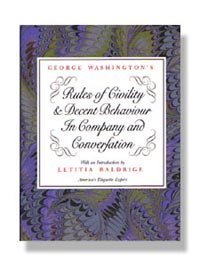
61, [3] pages. Frontis. Illustrations. With these 110 simple rules, the young George Washington embarked upon a lifetime of proper behavior in which good manners and etiquette guided him through two wars, the presidency and the live of a Virginia gentleman at his estate on the banks of the Potomac River. This charming new edition of George Washington's Rules of Civility includes examples of how he followed this code of conduct through his life, featuring illustrations from the Mount Vernon collection and an introduction by America's foremost etiquette expert, Letitia Baldrige. Rules of Civility & Decent Behaviour In Company and Conversation is the name of a list best known as a school writing exercise of George Washington, who became the first president of the United States of America. Most of the rules have been traced to a French etiquette manual written by Jesuits in 1595. As a handwriting exercise Washington may just have copied Francis Hawkins' translation which was published in England in about 1640. Nonetheless, the rules seem to have stuck deeply with Washington as he followed the propriety they conveyed throughout his life.Washington grew up lacking the gentlemen's education typically accustomed for the children of wealthy landowners. With few people to model his behavior on and an acute awareness of his lack of formal education, The Rules guided Washington's intentional actions, pronounced speech, civility to those of lower ranks, and respect for his superiors. Maxims like Rule 92, "Take no Salt or Bread with your Knife Greasy," and Rule 12, "Shake not the head, Feet, or Legs roll not the Eyes lift not one eyebrow high than the other wry not the mouth, and bedew no mans face with your Spittle, by approaching too near him when you Speak," indicated general actions to avoid in public. Other rules delved further into professional and personal actions. For example, Rules 40 and 68 encouraged humility in interaction by stating, "Strive not with your Superiors in argument, but always Submit your Judgment to others with Modesty," and "Go not thither, where you know not, whether you Shall be Welcome or not. Give not Advice without being Asked and when desired to do it briefly."Washington applied The Rules to various aspects of his life. During his military years, Washington expected a high level of decorum and cleanliness from his troops, referenced in Rule 51. He also promoted rules to his family, advising his stepgrandson, George Washington Parke Curtis that, "while a courteous behavior is due to all, select the most deserving only for your friendships," directly corresponding to Rule 56 which stated, "Associate yourself with Men of good Quality if you Esteem your own Reputation."Washington's written Rules were originally published, along with various samples of Washington's writings, in the mid-nineteenth century. They have and continue to appear in various newspapers across the country, and were first published in book form in 1888, with subsequent editions following. The widespread and continued publication of Washington's copy of The Rules has contributed greatly to the gentlemanly reputation that has helped define his image. Fourth Printing [stated] Copyright is 1989 for first printing thus.
Seller Inventory # 72573
Contact seller
Report this item