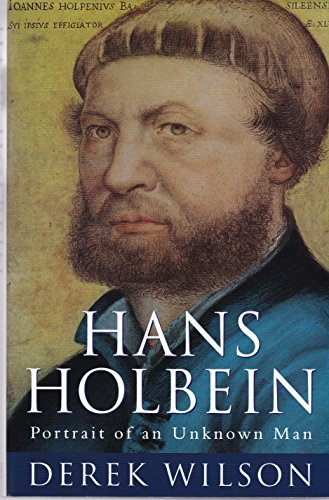
In the first full biography of Holbein for 80 years Derek Wilson marks the 500th anniversary of the birth of one of the most original and popular Renaissance artists. He reveals Hans Holbein the Younger (1497-1543) to us as a complex and fascinating man who knew and was influenced by the greatest thinkers of the age. He developed his own distinctive attitudes towards religion, politics and social life as he moved among stalwart burghers, merchant adventurers and the bejewelled denizens of a glittering court.
The Elizabethan artist Nicholas Hilliard recognised him as 'the greatest Master in [portraiture] that ever was'. Yet the range of Holbein's talent went far beyond painting likenesses. He was constantly in demand for trompe-l'oeil murals and intricate jewellery designs, and he revolutionized book illustration. He produced Catholic altarpieces and Protestant propaganda engravings, woodcuts and drawings depicting the stories of the Bible.
Derek Wilson draws on a wealth of research to challenge old assumptions about Holbein and to extend our knowledge of the Renaissance and the Reformation. He presents the artist as a man inextricably bound up in the stirring events of a creative and turbulent age; a man who knew Erasmus, Thomas More, Henry VIII and many of the sixteenth century's wielders of power and intellect; a man committed above all things to truth, who battled his own way through the cross-currents of religious and political change and, while pilgrimaging from Augsburg via Basel to London, found his ultimate fulfilment as a member of Thomas Cromwell's intelligence and propaganda organization.
As the subtitle of this intriguing speculative biography suggests, very little is known about Hans Holbein. Born in Augsburg in 1497, he encountered a Europe on the verge of great change. Perhaps he would have been less aware of this change had his father, a respected painter in his own right, not decided to send his sons away from Augsburg to study in the printing center of Basel, the Reformation's ground zero and, in Wilson's account, the formative influence on the 18-year-old newcomer's life. Wilson (A Tudor Tapestry) portrays such eminent figures as Erasmus, Zwingli and Luther, whose ideas were shaking Europe, and highlights their background in political and economic forces. The author's detective spirit is bent on restoring details effaced by time. Despite the paucity of documentation about his subject, Wilson offers an absorbing portrayal of Holbein's intellectual culture and forges convincing links to the many artworks that have been preserved. Holbein's last years at Henry VIII's Tudor court produced some of his finest works--The Ambassadors and his various wedding portraits, among others. Wilson tries a little too hard to convince readers that Holbein's early fervent spiritual commitment continued--though restrained--through his difficult later days with Henry VIII. But this is a slight wobble in an otherwise fine biography.
Copyright 1997 Cahners Business Information, Inc.