About this Item
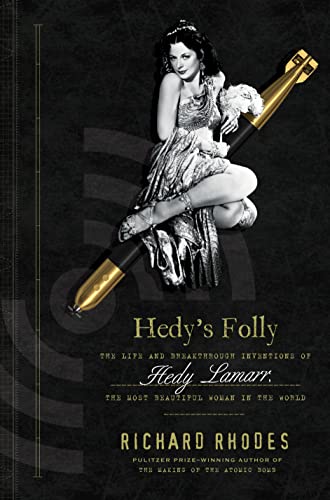
Format is approximately 5.75 inches by 8.5 inches. ix, [1], 261, [1] pages. Illustrations. Notes. References. Index. Richard Lee Rhodes (born July 4, 1937) is an American historian, journalist, and author, including the Pulitzer Prize-winning The Making of the Atomic Bomb. He also frequently gives lectures and talks on a broad range of subjects, including testimony to the U.S. Senate on nuclear energy. Hedy Lamarr (born Hedwig Eva Maria Kiesler; November 9, 1914 - January 19, 2000) was an Austrian-born American film actress and inventor. She has been described as one of the great movie actresses of all time. She met Metro-Goldwyn-Mayer studio head Louis B. Mayer, who offered her a movie contract in Hollywood. She became a film star with her performance in Algiers. Her MGM films include Lady of the Tropics, Boom Town, H. M. Pulham, Esq., and White Cargo. Her greatest success was as Delilah in DeMille's Bible-inspired Samson and Delilah. She also acted on television before the release of her final film, The Female Animal (1958). She was honored with a star on the Hollywood Walk of Fame in 1960. At the beginning of World War II, she and composer George Antheil developed a radio guidance system for Allied torpedoes that used spread spectrum and frequency hopping technology to defeat the threat of jamming by the Axis powers. The principles of their work are incorporated into Bluetooth and GPS technology. This work led to their induction into the National Inventors Hall of Fame in 2014. What do Hedy Lamarr, avant-garde composer George Antheil, and your cell phone have in common? The answer is spread-spectrum radio: a revolutionary invention based on the rapid switching of communications signals among a spread of different frequencies. Without this technology, we would not have the digital comforts that we take for granted today. Only a writer of Richard Rhodes's caliber could do justice to this remarkable story. Unhappily married to a Nazi arms dealer, Lamarr fled to America at the start of World War II; she brought with her not only her theatrical talent but also a gift for technical innovation. An introduction to Antheil at a Hollywood dinner table culminated in a U.S. patent for a jam- proof radio guidance system for torpedoes, the unlikely duo, s gift to the U.S. war effort. What other book brings together 1920s Paris, player pianos, Nazi weaponry, and digital wireless into one satisfying whole? In its juxtaposition of Hollywood glamour with the reality of a brutal war, Hedy's Folly is a riveting book about unlikely amateur inventors collaborating to change the world. Derived from a Kirkus review: The surprising story of a pivotal invention produced during World War II by a pair of most unlikely inventorsâ "an avant-garde composer and the world's most glamorous movie star. Rhodes offers the stories of his two principals in alternating segments, sometimes chapter-length. The diminutive pianist/composer George Antheilâ "who worked with Stravinsky, Ezra Pound, Balanchine, DeMille and other notablesâ "was also a prolific writer and inventor. And Lamarr (born Hedwig Kiesler), smitten by the theater in her native Austria, married a wealthy man charmed by Nazis; she later fled for Hollywood, where she quickly established herself as a major star in such films as Algiers and Ziegfeld Girl. She crossed trails with Antheil, who'd also moved west. Rhodes shows us that Lamarr (a new surname name suggested by the wife of Louis B. Mayer) was extremely bright (though poorly educated), a woman who had an area in her house devoted to inventing. And Antheilâ "who'd once composed a piece requiring 16 synchronized player pianosâ "had inventing interests that dovetailed with Lamarr's. They worked together to invent a way to radio-guide torpedoes and to use a technique called frequency-hopping to insure that the enemy could not jam their signals. Lamarr and Antheil secured a patent, but the U.S. Navy did not adopt the device, which, as Rhodes shows, w.
Seller Inventory # 84202
Contact seller
Report this item