About this Item
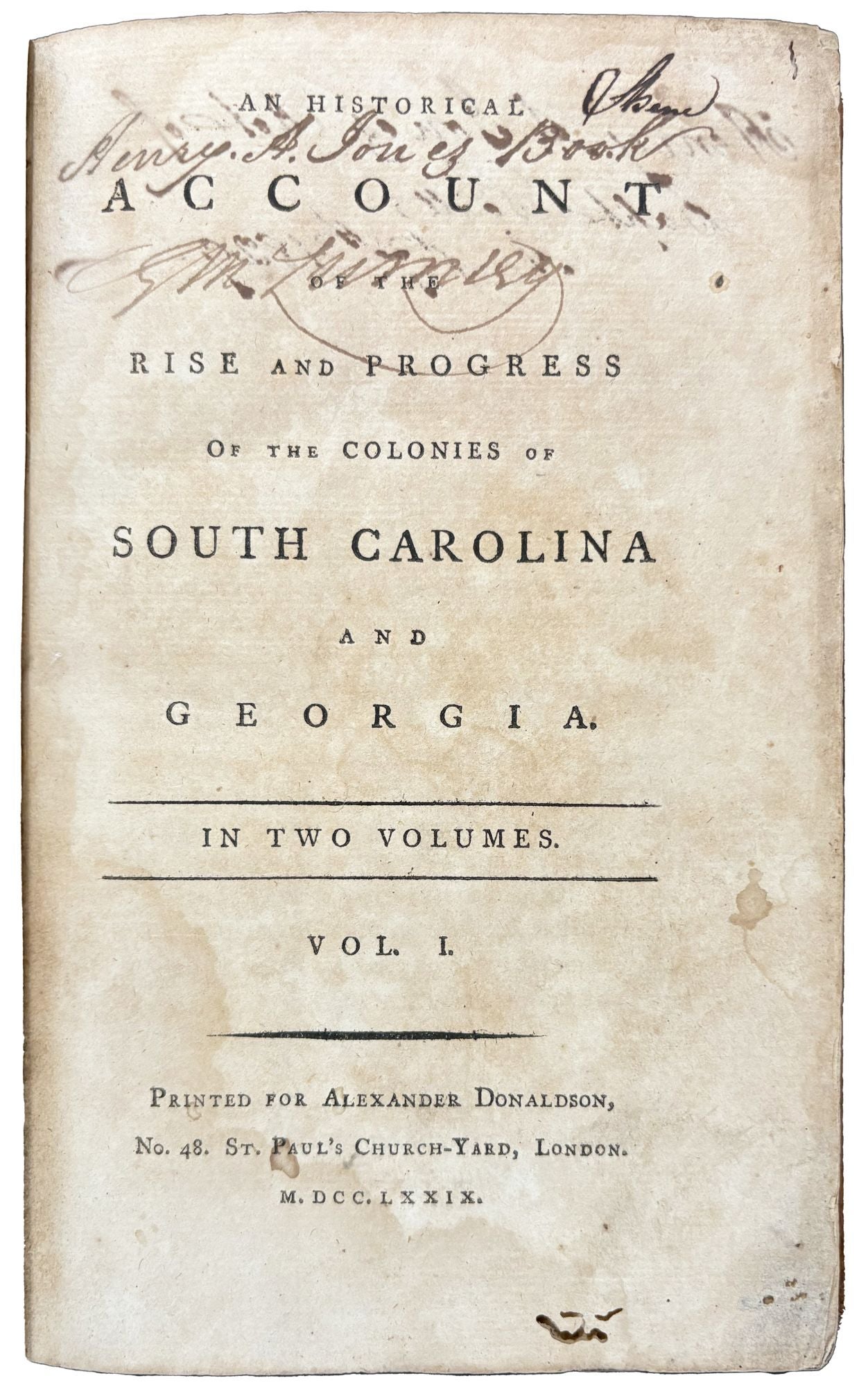
(8 1/4 x 5 inches). First edition. Volume I: a-b4 A-Uu4 Xx2. [i]-xiv [2] [1]-347 [1]. 364 pp. Title, Preface, Contents, Chapters I-VI, The First Set of the Fundamental Constitutions of South Carolina as Compiled by Mr. John Locke. Volume II: a4 b1 A-Ss4 [x]1. [i]-ix [1] [1]-329 [1]. 340 pp. Last page misnumbered 309. Title, Contents, Chapters VII-XI, With inscriptions of "Henry A. Jones" on both volumes, unclear if it is the playwright of the same name. Bound to style in 18th-century calf, spines with raised bands forming compartments, gilt lettered red morocco lettering pieces in second compartments. Restoration to the the last text leaf in volume one First edition of the fundamental historical account of South Carolina and Georgia, which Howes calls "the earliest history of this region," and Winsor states is the "earliest account of South Carolina cast in a sustained retrospective spirit." [Streeter] Hewatt (or Hewat), was a Scottish-born Presbyterian minister educated at Edinburgh who presided over the Scots First Presbyterian Church in Charleston (when it was Charlestown), South Carolina, from 1763 to 1777. When the British fleet arrived at Charlestown in 1776, Hewatt and other ministers were forced by Patriots to renounce their loyalty to the king. When he refused, Hewatt was given sixty days to leave the colony. His property was seized and he returned to the British Isles and wrote this historical account in London. Considered by Howe to be the earliest and best account of Colonial South Carolina and Georgia, the book is bolstered by, as Streeter states, Hewatt being a "keen collector of historical documents." However, his work remains important today because it is also based on his personal observations as a first-hand source from over a decade of lived experience in the region. Hewatt discusses the immigration of British, French, and other European migrants to the Carolinas due to religious persecution at home. He examines the lives they then created in the New World and the economies they built while doing so. But Hewatt also pays especial detail to the customs and cultures of those people these settlers displaced: the indigenous Native Americans of the region. "Hewatt gives a sympathetic and balanced account of Indian life and customs. He describes the climate, soil, natural resources, fauna, snakes and insects; how to make turpentine, tar, and pitch; and how to cultivate silk, cotton, and especially rice." [De Renne] An opponent of slavery, as many Presbyterians were, he chronicles the introduction of enslaved people from Africa and the ensuing social and economic problems it caused. He criticizes slavery in the colonies and the treatment of enslaved people, while maintaining that they should be given instruction in morals and religion. He also warns that to mistreat enslaved people was to "fire them with desires of liberty and vengeance." Also covered in Volume I is the Yamasee War, and in Volume II the War with the Cherokee. In 1780, after the publication of this work, Hewatt was awarded the Doctor of Divinity from the University of Edinburgh, an indication of the success of the present book. "Hewatt's account reflects the influence of William Robertson and the Scottish school of historiography. Less concerned with a chronology of events, Hewatt instead focused on the interrelatedness of those events and their various causes and effects. His goal in doing so was to provide moral, political, and practical instruction to the colonists and to those in England." [ANB] His work, especially his comments on Native Americans and enslaved people, were used as the basis for David Ramsay's history, though it went uncredited. The first volume includes the "first set of the fundamental constitutions of South Carolina" which have been attributed to the English political philosopher John Locke, because he, at the time, was working as a paid secretary for one of the Province of Carolina's proprietors, Anthony Ashley Cooper. The h.
Seller Inventory # 40925
Contact seller
Report this item