About this Item
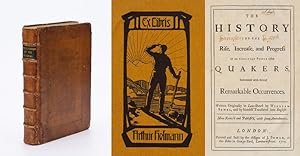
First English-language edition, following the low Dutch edition of 1717. Folio (21 cm x 31 cm). [12], 723, [19] pages (including a thorough Index), plus 4 unnumbered pages of a catalogue of "Books Printed and Sold by the Assigns of J. Sowles". Hardcover / Original, late 18th century leather with original spine-label and ornament to boards. Six raised bands; spine starting but still firm and holding. Overall very good condition. Bookplate / Exlibris of Arthur Hofmann to pastedown. Excellent and interesting provenance this being one of the most important publications on Quaker - History and originating from one of the oldest and most influential Quaker - Families in England and Wales. It is possible that two Sampson's of the Quaker - Family of the Birmingham Lloyd's owned this book, according to the titlepage and the apparent signatures: We believe it was originally owned [Larger, older signature]: 1. Sampson Lloyd (1664 3 January 1724) was an iron manufacturer in Birmingham, then a small town in the county of Warwickshire, England, and was the founder of the Lloyd family of Birmingham, iron-founders and bankers, which went on to found Lloyds Bank, today one of the largest banks in the United Kingdom. He was the younger son of Charles Lloyd (1637 1698) of Dolobran in Montgomeryshire (now Powys), where the Lloyd family had been established gentry for many centuries. Sampson's mother was his father's first wife Elizabeth Lort (1633 1685), daughter of Sampson Lort (died before 1670) of East Moor in Pembrokeshire, one of the three sons of Henry Lort of Stackpole Court in Pembrokeshire, Sheriff of Pembrokeshire in 1619, of whom the eldest was Sir Roger Lort, 1st Baronet (died 1664), created a baronet in 1662. Sampson was born in 1664 "at Anne Eccleston's in Welshpool", the rented house where his parents had been held for the previous two years under house arrest, having been transferred from the Welshpool jail, and where they would remain for the next eight years, having as Quakers refused to take the Oath of Allegiance to King Charles II (1660 1685) as required by the Quaker Act of 1662, the swearing of oaths being forbidden by the Quaker religion. He adhered to the Quaker faith which had been adopted by his father and aged 34 in the year 1698, the year of his father's death, leaving his elder brother Charles Lloyd (1662 1747), who had inherited Dolobran, he deserted the "uncharitableness of his native Wales" and moved about 62 miles south-east of Dolobran to the town of Birmingham in Warwickshire (home of his brother-in-law John Pemberton), a town especially tolerant of Quakers and religious dissent. There he could escape the harassing and ruthless legal penalties of the Conventicles Act and Five Mile Act, for as Birmingham was not then a borough, dissenting preachers were not barred from preaching there. He might have been tempted to follow thousands of other Welsh dissenters in emigrating to the new American colony of Pennsylvania, which course had been chosen by his uncle Thomas Lloyd (1640 1694) a Quaker and preacher who assisted William Penn in the establishment of that colony, which he served as Deputy-Governor and President from 1684 to 1693. However, Birmingham had other attractions than religious toleration to Sampson. It was a place where due to the absence of guilds controlling trade and industry, it was easy to establish a business or factory. There he "soon found scope for his energies and capital" and became an ironmaster and established a slitting mill at the bottom of Bradford Street, Birmingham, on the bank of the River Rea, where by use of water power, sheet iron was cut-up to form nails. Slitting mills were especially plentiful on the River Stour between Stourbridge (where Sampson's father-in-law Ambrose Crowley operated) and Stourport. He also started business as an iron merchant in Edgbaston Street, Birmingham, in which he lived at number 56. He had a profitable career in the firm he founded called "Sampson Llo.
Seller Inventory # 31185AB
Contact seller
Report this item