Synopsis
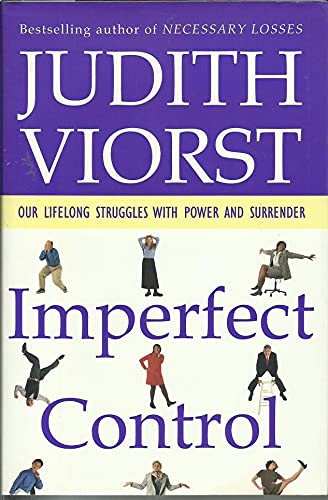
The best-selling author of Necessary Losses addresses the issue of control--with its associated feelings of power, helplessness, freedom, and limitations--and how it affects every area of our lives. 125,000 first printing. Tour.
Reviews
Oh, what a lovely book--popular psychology at its best: a multifaceted study of an important, lifelong personal and interpersonal issue, written crisply, enjoyably, and informatively. A bestselling writer of nonfiction (Necessary Losses, 1986), a novel (Murdering Mr. Monti, 1994), and children's books, Viorst writes about the many issues of achieving control. She marshals a host of interesting observations--her own and others', such as psychologist Althea Horner's point that adolescents often achieve ``illusory power,'' rejecting parental control only to submit to that of another person, group, or social force (e.g., an idealized mentor, friends and other peers, or the values of MTV). For adults, even emotional fragility and physical illness may be used in the service of interpersonal control: ``The person running the show may be Poor Little Me,'' Viorst maintains tartly. Perhaps her best chapter, however, is on that most painful and unavoidable of subjects: the choices each of us must make at the end of life. Viorst makes a good, if undoubtedly highly controversial, case for ``rational suicide'' under certain stringent circumstances. More generally, she explores the terminally ill person's need to maintain a measure of control over how he or she dies, balanced ultimately by what Rabbi Leonard Beerman describes as ``a willed decision, an active choosing to let go.'' Like Necessary Losses, Viorst's new book deserves a very broad audience. Among them should be aspiring writers of good, popular nonfiction. Such prose looks easy, but it is anything but. It requires choosing an intriguing undercovered subject, doing extensive research among specialists, as well as mining the relevant literature and one's own experience, and perhaps above all, telling memorable anecdotes and otherwise maintaining a compelling narrative. By these standards, Viorst is an exceptionally fine popularizer, indeed. -- Copyright ©1997, Kirkus Associates, LP. All rights reserved.
Viorst (Murdering Mr. Monti, LJ 12/93) suggests that we tend to exhibit "imperfect control" in our day-to-day existence. Taking an eclectic approach to her topic, she recognizes nature, nurture, and environment as all strongly influencing our struggles with control. Referring to the works of social scientists, psychologists, and philosophers as well as literary examples and personal experiences, Viorst shows how issues of power and surrender confront and affect us throughout our lives. With a new understanding of the possibilities and limits of our control, she ably demonstrates how we can better shape our lives through wiser choices and actions. Her book is very readable, with traces of the author's special brand of humor woven throughout. Highly recommended for psychology collections in all academic and public libraries and for all readers who wish to have a better understanding of the behavior of self and others.
-?Elizabeth Goeters, DeKalb Coll. Learning Resources Ctr., Dunwoody, Ga.
Copyright 1997 Reed Business Information, Inc.
"About this title" may belong to another edition of this title.