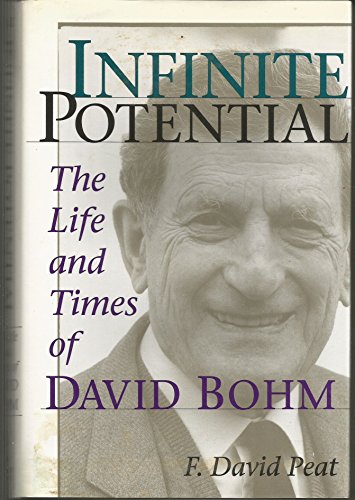
Synopsis
Recounts the life of the physicist, psychologist, and philosopher David Bohm, including his friendship with J. Robert Oppenheimer and his protest against Senator Joseph McCarthy, and explains his landmark scientific discoveries and his work with Eastern philosophy.
Reviews
Dismissed by establishment scientists as a maverick or mystical rebel, American physicist David Bohm (1917-1992) sought a holistic physics, a unified vision of matter and mind, brain and consciousness. His search for an alternative quantum theory led him to formulate a cosmology depicting a universe of infinite levels, each qualitatively different yet part of an interconnected whole. In this brilliant intellectual biography, science writer Peat, Bohm's longtime friend and colleague, portrays an intensely cerebral man gripped by periods of crippling depression, who had an acute need of a guru or father figure, whether mentor J. Robert Oppenheimer or Indian philosopher/ teacher Jiddu Krishnamurti, and who ultimately felt betrayed by each of them. Born in Pennsylvania to a Hungarian Jewish immigrant father and a manic-depressive mother of Lithuanian Jewish extraction, Bohm, who settled in London in the late 1950s, was a disillusioned Marxist thinker (he briefly joined the U.S. Communist Party in 1942) who bravely refused to name names to a Congressional witchhunt committee when called to testify in 1949. Peat's probing exploration of Bohm's quest for an "implicate order," a deeper reality beneath the surface appearance of things, helps explain his influence on writers, artists, psychologists and philosophers as well as open-minded physicists.
Copyright 1996 Reed Business Information, Inc.
Science writer Peat, who with Bohm coauthored Science, Order and Creativity (LJ 11/15/87), writes with compassion and warmth about the famous physicist. He covers Bohm's entire personal and professional lives (he died in 1992), from childhood as the son of a poor Jewish immigrant to becoming one of the most influential thinkers of the 20th century. Much of Bohm's work?the development of plasma theory and subsequent work with solid-state physics, his famous hidden-variables interpretation of quantum mechanics?was worthy of a Nobel Prize. Einstein once spoke of Bohm as his intellectual successor, but because of his unconventional political views and the McCarthy blacklisting madness, he was forced to become an expatriate in Brazil. Bohm's desire for an understanding of the universe at its most fundamental level led him to study philosophy and metaphysics. Peat's excellent biography is highly recommended for academic and large public libraries.?James Olson, Northeastern Illinois Univ. Lib., Chicago
Copyright 1996 Reed Business Information, Inc.
"About this title" may belong to another edition of this title.