About this Item
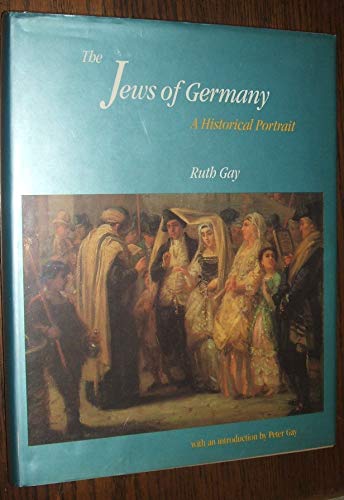
Oversized book, measuring 8-1/2 by 11-1/4. xiii, [1], 297, [1] pages. Illustrations (some in color). Gift inscription, not from the author, on fep. Introduction by Peter Gay. Includes chapters on Origins; The Institutions of Jewish Life; From the Middle Ages to the Court Jews; The Return to History; The Struggle for Emancipation; In the Fifty-Year Empire; and The End. Also includes Further Reading, Acknowledgments, Credits, and Index. This unique book provides a panoramic over view of the 1600 year history of the Jews in Germany. Through texts, pictures, and contemporary accounts, it follows the German Jews from their first settlements on the Rhine in the fourth century to the destruction of the community in World War II. Using both voices and images of the past, the book reveals how the German Jews looked, how they lived, what they thought about, and what others thought of them. Ruth Gay's text, interwoven with excepts from memoirs, letters, newspapers, and many other contemporary sources, shows how the German Jews organized their communities, created a new language (Yiddish), and built their special culture--all this under circumstances sometimes friendly, but often murderously hostile. The book explains the internal debates that agitated the community from medieval to modern times, and analyzes how German Jewry emerged into the modern world. The earliest document in the book is a fourth-centrury decree by the Emperor Constantine permitting Jews to hold office in Cologne. Among the last are letters, written in Nazi Berlin, from Betty Scholem to her son Gershom in Palestine. Ruth Gay (née Slotkin; October 19, 1922 - May 9, 2006) was an American Jewish writer whose work concerned Jewish life. She won the 1997 National Jewish Book Award for non-fiction for Unfinished People: Eastern European Jews Encounter America (1996). In 2002, she published "Safe Among the Germans: Liberated Jews After World War II" through the Yale University Press. Peter Joachim Gay (né Fröhlich; June 20, 1923 - May 12, 2015) was a German-American historian, educator, and author. He was a Sterling Professor of History at Yale University and former director of the New York Public Library's Center for Scholars and Writers (1997-2003). Gay received the American Historical Association's (AHA) Award for Scholarly Distinction in 2004. He authored over 25 books, including The Enlightenment: An Interpretation, a two-volume award winner; Weimar Culture: The Outsider as Insider (1968), a bestseller; and the widely translated Freud: A Life for Our Time (1988). Derived from a Kirkus review: The history of Jews in Germany begins with the third century A.D., when a settlement at Cologne was paying taxes to the Emperor Constantine. It ends in 1943, the year Hitler declared the country ``Judenrein''?free of Jews. By then, 170,000?out of a community of half a million?had perished in the camps. The rest had emigrated. This fascinating account by Gay covers not only the tragedies leading up to the ultimate one, but the triumphs of nearly two millennia. Above all, Gay describes the strategies of day-to-day survival for rich and for poor, Prussians and Alsatians, city and country folk, men and women?making dozens of useful distinctions overlooked in our standard simple notion of what it meant to be a German Jew. Yes, the Lateran Council in 1215 required that Jews wear distinctive headgear. But at the same time, the legends of King Arthur were circulating in rhymed Yiddish couplets. Yes, a few Jews were financial advisers to dukes and princes and, later, stunningly successful capitalists. But most lived in rural poverty as late as the 19th century, when 120,000 emigrated to the US. Gay's text is easy to follow, and the copious illustrations (277 b&w; ten color) include woodcuts, engravings, photographs of forgotten ancestors, and facsimile pages of historic documents. Almost every page offers some intriguing tidbit. A Jewish envoy of Charlemagne brought a white elephant back t.
Seller Inventory # 82544
Contact seller
Report this item