Synopsis
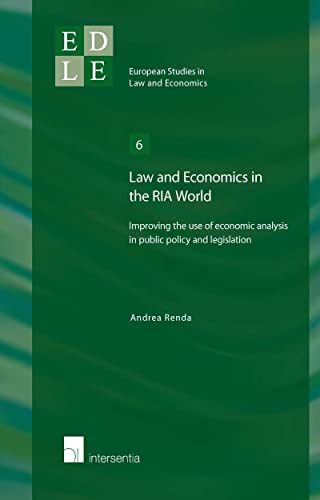
The use of economics in public policy, in the form of ex ante Regulatory Impact Analysis (RIA), is strongly advocated by international organizations, such as the Organization for Economic Co-operation and Development and the World Bank. In the US and the EU, hundreds of RIAs are produced every year to justify public intervention in the form of regulation. But, reality shows that, in many other countries, the adoption and implementation of this tool has been patchy at best. At the same time, the use of economics in RIA is heavily challenged by scholarly developments, such as behavioral economics, neuroeconomics, and the study of social norms, and was unable to predict and cure the financial crisis that hit the global economy in 2007. This book claims that RIA should incorporate recent developments from law and economics literature. It provides an analysis of the potential contribution of positive, normative, and functional schools of law and economics to the practice of RIA. The book contains thematic applications to policy fields, such as environmental protection, energy efficiency, financial markets, antitrust, cyberspace, and telecommunications. It provides far-reaching recommendations on the future of law and economics, as well as on the organization of RIA systems around the world, particularly in the US and the EU. (Series: European Studies in Law and Economics - Vol. 6)
About the Author
Andrea Renda is a Senior Research Fellow at the Centre for European Policy Studies (CEPS) and a co-manager of the CEPS Digital Forum. He provides academic advice to several institutions, including the European Commission, the European Parliament, the OECD and the World Bank. He is Senior Lecturer of “Economic Analysis of Law”, “Antitrust and regulation”, “Policies and policymaking in the EU” and “Regulatory Policies in a global perspective” at Luiss Guido Carli University, in Rome, and a Senior Research Fellow at Luiss’ Law and Economics Lab. He lectured in the past years at the Erasmus University of Rotterdam, at the University of Stockholm, the University of Jordan, at the College of Europe in Bruges and at Fudan University in Shanghai. He is member of the Editorial Board of “Telecommunication Policy” and the “European Journal of Risk Regulation”; a member of the Scientific Board of the International Telecommunications Society (ITS) and the Scientific Chair of the Scientific Board of EuroCPR. He is a member of the Istituto Affari Internazionali, where he manages the Global Outlook program. He earned a BA cum laude in Economics from LUISS Guido Carli University, Rome, in 1995 (Dissertation awarded a special distinction) and is European Master of Law and Economics (LL.M., with distinction, University of Hamburg, 1996). He holds a PhD degree in Law and Economics awarded by the Erasmus University of Rotterdam. He is the author of several publications.
"About this title" may belong to another edition of this title.