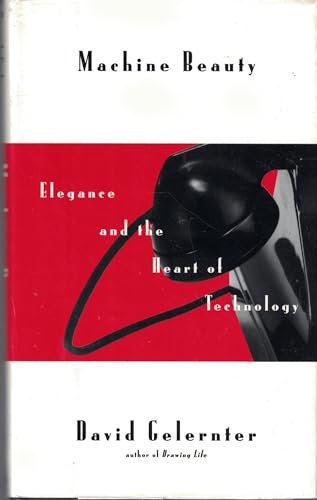
When something works well, you can feel it; there is a sense of rightness to it. We call that rightness beauty, and it ought to be the single most important component of design.This recognition is at the heart of David Gelernter's witty argued essay, Machine Beauty, which defines beauty as an inspired mating of simplicity and power. You can see it in a Bauhaus chair, the Hoover Dam, or an Emerson radio circa 1930. In contrast, too many contemporary technologists run out of ideas and resort to gimmicks and features; they are rarely capable of real, structural ingenuity.Nowhere is this more evident than in the world of computers. You don't have to look far to see how oblivious most computer technologists are to the idea of beauty. Just look at how ugly your computer cabinet is, how unwieldy and out of sync it feels with the manner and speed with which you process thought.The best designers, however, are obsessed with beauty. Both hardware and software should afford us the greatest opportunity to achieve deep beauty, the kind of beauty that happens when many types of loveliness reinforce one another, when design expresses an underlying technology, a machine logic. Program software ought to be transparent; it should engage what Gelernter calls ”a thought-amplifying feedback loop,” a creative symbiosis with its user. These principles, beautiful in themselves, will set the stage for the next technological revolution, in which the pursuit of elegance will lead to extraordinary innovations. Machine Beauty will delight Gelernter's growing audience, fans of his provocative and biting journalism. Anyone who manufactures, designs, or uses computers will be galvanized by his cogent arguments and tantalizing glimpse of a bright future, where beautiful technology abounds.
Although based on a solid thesis?that great design is the marriage of simplicity and power?Gelernter's chronicle of beauty's role in the "rise of the desktop" often amounts to little more than a rehash of the rise of the Macintosh through the lens of aesthetics, plus some promotion for his own software. A Yale technologist who survived a 1993 Unabomber attack (described in his Drawing Life, 1996), Gelernter begins by demonstrating the affinity between the good design of computer hardware and software and the form-driven innovations of the Bauhaus. Soon, however, he is explaining Microsoft's triumph over Apple as at least partly due to the fact that "elegance gives everyone the creeps." A later chapter tells the story of the shift from time-sharing computing to the personal computer, and of the creation of a window-based operating system at a Xerox think tank?which Apple then co-opted. In the name of demonstrating alternatives to current modes of Web surfing and multimedia computing, Gelernter introduces his own computer programming language, "Linda," and "Lifestreams," a system for navigating the Web's info-glut. Gelernter envisions everyone having a personal Lifestream by 2010?a Web site where you receive personalized culls from the Web and conduct all personal business. While Gelernter's observations on how ideas get promulgated in the highly competitive world of computer futurism ring true, his paeans to his favorite products serve to obfuscate rather than illuminate his otherwise intriguing discussion of how design works in the realm of computer science and industry.
Copyright 1998 Reed Business Information, Inc.
Gelernter, a computer science professor at Yale and recipient of one of the Unabomber's letter bombs, explains how beauty and elegance characterize the most important developments in computational history. He argues further that the lack of such elegance characterizes too much of our current technological output, which is often overburdened with unnecessary or useless features. Gelernter provides many examples of beauty in technology, from elegant mathematical solutions to the Apple Computer concept of the "desktop." Here he makes a strong argument for a different approach to teaching computer science and recommends that all science programs require classes in art history and appreciation to develop an understanding of what constitutes beauty and elegance. The author concludes that we have the potential and capacity to create "machine beauty." A well-written and thought-provoking book. [See also Gelernter's Drawing Life: Surviving the Unabomber, reviewed on p. 202.?Ed.]?Hilary Burton, Lawrence Livermore National Lab., Livermore, Cal.
-?Hilary Burton, Lawrence Livermore National Lab., Livermore, Cal.
Copyright 1997 Reed Business Information, Inc.