Synopsis
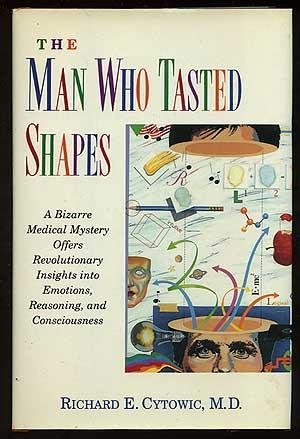
Uncovers the strange medical mystery of synesthesia, a condition in which people can taste shapes or hear and smell colors, and suggests that everyone has synesthetic powers.
Reviews
In 1979, neurologist Cytowic met a man who literally tasted shapes, and a woman who heard and smelled colors. These otherwise normal people had synesthesia, an exceedingly rare perceptual disorder in which the senses become intermingled. What Cytowic learned from them is told here through the portraits of the synesthetes and through his own detective work and consultations with medical colleagues. There is an appealingly suspenseful quality to this reportage, and the--worth waiting for--denouement is that synesthetes see nothing less than the building blocks of perception normally hidden from consciousness. Artfully drawing back the curtain of consciousness, the author suggests that synesthetes temporarily experience a shutdown of the left hemispheric cortex. The interesting implications he extracts from this finding are that consciousness is emotional rather than rational, that the emotional part of the brain--the limbic system--evolved just as much as the cortex, and that our actions are guided by a wisdom that is not apparent to the conscious mind. Also noteworthy is Cytowic's discussion of art and creativity. Artists are among the few who are able to tap into their emotive knowledge, he maintains. Among Cytowic's conclusions: Ravel and Kandinsky were synesthetes, and Scriabin and Kodaly were aware of the condition,whose existence motivated them to find colors to match tones. Photos not seen by PW.
Copyright 1993 Reed Business Information, Inc.
When a curious-minded neurologist meets a neurological curiosity--in this case, a neighbor who experiences tastes as physical shapes--the result, at least here, is a mixed bag: a fascinating scientific exploration of that rare sensory linkage and overlapping called synesthesia plus less interesting ponderings on the nature of the human mind. Washington, D.C., neurologist Cytowic was so intrigued to learn that his neighbor ``Michael'' possessed synesthesia--a trait found in only ten people per million--that he enlisted him in a research project to explore this mysterious phenomenon. Here, Cytowic divides his report on synesthesia into two sections. The first, ``A Medical Mystery Tale,'' is an account of his research and medical findings. Michael, the author tells us, cooperated in countless tedious tests and eventually even agreed to an angiogram to determine the pattern of blood flow in his brain. From this research, Cytowic concluded that synesthesia is localized in the limbic system of the brain's left hemisphere-- and that it's a normal brain function that's always existed in everyone but has been lost from conscious awareness in all but a few individuals. Apparently solving the mystery of synesthesia, Cytowic created a new conception of the organization of the mind- -one that places greater importance on the limbic system and thus on the primacy of emotion over reason. While the cortex analyzes what's going on in the world, he contends, the limbic system gives value to events. In the second part of the text, ``Essays on The Primacy of Emotion,'' the author looks at the implications of his findings. In pieces that discuss imagination, objectivity and subjectivity, consciousness, reason, and spirituality, he would have us understand that behind the rational mind is another irrational, emotional one that's really in charge. An absorbing tale of medical detection coupled with less- than-gripping philosophical musings. (Photographs, line drawings- -not seen) -- Copyright ©1993, Kirkus Associates, LP. All rights reserved.
A practicing neurologist, Cytowic has authored journal articles as well as a textbook on synesthesia. In this popular account, he describes this rare medical condition, in which one sense of the synesthete involuntarily conjures up another. An artist whose sense of taste elicts the sense of touch became the primary subject of a series of experiments in which Cytowic demonstrated that the limbic system is essential for the expression of synesthesia. This discovery has profoundly influenced our understanding of the brain and the primary role played by emotion. In a series of thought-provoking essays, the author expounds upon the issue of subjective experience. Readers familiar with Oliver Sacks's extraordinary neurological tales will find Cytowic's book equally engaging.
- Laurie Bartolini, Lincoln Lib., Springfield, Ill.
Copyright 1993 Reed Business Information, Inc.
"About this title" may belong to another edition of this title.