About this Item
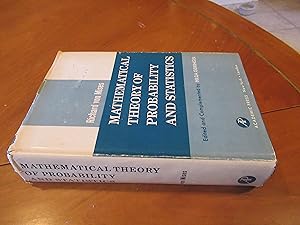
694 Pp. Turquoise Cloth. First Printing. Lectures At Harvard University Form The Basis Of This Massive Overview, Supplemented By Material From His Papers And Notebooks Edited By Geiringer. Book Is Near Fine, No Names Or Marks, Light Rubbing At Corners, Former Owner's Bookplate And Ink Price On Front Pastedown. Dust Jacket With Light Wear, A Few Tiny Tears And Losses At Edges. (From Wikipedia): Richard Edler Von Mises (1883 ?1953) Was An Austrian Scientist And Mathematician. He Described His Work Shortly Before His Death As Being On ". Practical Analysis, Integral And Differential Equations, Mechanics, Hydrodynamics And Aerodynamics, Constructive Geometry, Probability Calculus, Statistics And Philosophy. Although Best Known For His Mathematical Work, Mises Also Contributed To The Philosophy Of Science As A Neo-Positivist And Empiricist, Following The Line Of Ernst Mach. Historians Of The Vienna Circle Of Logical Empiricism Recognize A "First Phase" From 1907 Through 1914 With Philipp Frank, Hans Hahn, And Otto Neurath. His Older Brother, Ludwig Von Mises, Held An Opposite Point Of View With Respect To Positivism And Epistemology. His Brother Developed Praxeology, An A Priori View. During His Time In Istanbul, Mises Maintained Close Contact With Philipp Frank,[5] A Logical Positivist And Professor Of Physics In Prague Until 1938. His Literary Interests Included The Austrian Novelist Robert Musil And The Poet Rainer Maria Rilke, On Whom He Became A Recognized Expert. Before The War He Had Already Become A Pilot And Lectured On The Design Of Aircraft, And In 1913 At Strasbourg He Gave The First University Course On Powered Flight. After The War, Mises Held The New Chair Of Hydrodynamics And Aerodynamics At The Dresden Technische Hochschule. In 1919 He Was Appointed Director (And Full Professor) At The New Institute Of Applied Mathematics . With The Rise Of The National Socialist Party To Power In 1933, Mises Felt His Position Threatened, Despite His First World War Military Service. He Moved To Turkey, Where He Held The Newly Created Chair Of Pure And Applied Mathematics At The University Of Istanbul. In 1939 He Accepted A Position In The United States, Where In 1944 He Was Appointed As Gordon Mckay Professor Of Aerodynamics And Applied Mathematics At Harvard University. His Ideas On Probability, However, Were Not Well Received, Yet Andrey Kolmogorov, Whose Rival Axiomatisation Was Better Received, Was Less Severe: "The Basis For The Applicability Of The Results Of The Mathematical Theory Of Probability To Real 'Random Phenomena' Must Depend On Some Form Of The Frequency Concept Of Probability, The Unavoidable Nature Of Which Has Been Established By Von Mises In A Spirited Manner.".
Seller Inventory # 046937
Contact seller
Report this item