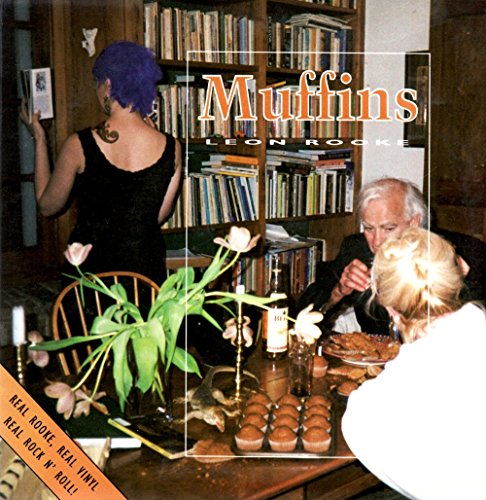
`Muffins is a square; it has a vinyl cover of a photograph of Rooke and his wife and another woman (their daughter?). The photograph-cover, if one ``reads'' it closely, shows the daughter reading a book; her back is facing her parents who are at a table eating -- or about to eat -- muffins. There is a book case stuffed with books ``arranged'' in a messy way. The photograph has in the middle a rectangle in white lines and the words in different typefaces (and colours): Muffins and Leon Rooke under Muffins. The effect is startling because I see photographs of books within the book itself. And I am thus aware that there is a carefully designed book-within-the-book. And I start thinking about the relation of the various elements I have mentioned. Is the cover the beginning of the book? Does it, on the contrary, tell a secret story? I see, finally, that I as reader or viewer must interpret the relations, must join -- or create -- the performance of interpretation. In a sense, then, I am writing a review of the photograph of the author. And I have not yet opened Muffins! My consciousness is whirling!'
An energetic and prolific storyteller, Leon Rooke's writing is characterized by inventive language, experimental form and an extreme range of characters with distinctive voices. He has written a number of plays for radio and stage and produced numerous collections of short stories. It is his novels, however, that have received the most critical acclaim. Fat Woman (1980) was shortlisted for the Governor General's Award and won the Paperback Novel of the Year Award. Shakespeare's Dog<