Synopsis
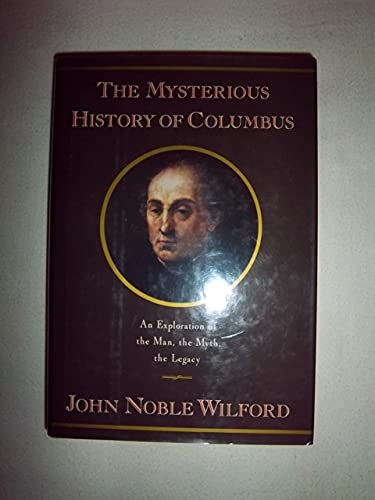
Sheds new light on the life, times, and legacy of Christopher Columbus, answering questions about his voyages, the myths surrounding him, and his impact on world history
Reviews
YA-- A highly readable overview of the Columbus story, as seen from the Middle Ages to the present. Wilford tells what little is known of Columbus's life, and also puts the discoveries in context. He examines the varying attitudes toward the explorer through the centuries, reaching the conclusion that the truth lies somewhere between the adulation of 100 years ago and the present disparagement by Native American groups. Thoughtfully written and hard to put down.
Copyright 1992 Reed Business Information, Inc.
With this comprehensive sifting of 500 years of legend, historical documentation and social theory, Pulitzer Prize-winning New York Times reporter Wilford attempts with considerable success to tell, in his words, "the story of the story of Columbus." Underlining the meager certainties concerning Columbus's personal life, Wilford points out the biases informing most extant documents--e.g., Columbus's own letters and the biography written by his son Ferdinand, known as Hernando. Wilford evaluates subsequent Columbus studies, such as Samuel Eliot Morison's 1942 biography Admiral of the Ocean Sea and addresses some more recent revisionist issues by detailing early slavery practices and the cruelty of Europeans toward native peoples. In Wilford's view, Columbus belonged more to the Middle Ages than to the Renaissance in forcing experience to fit expectations; his tenacious pursuit of his vision may have been powerfully propelled by a personal spirituality. Wilford's account is sometimes lumbering, but overall he effectively cuts through a morass of conflicting, often unreliable sources to give readers a perspecitve on the world's developing views of his subject's momentous "discovery."
Copyright 1991 Reed Business Information, Inc.
An exciting probe of the great discoverer and the countless enigmas surrounding his life and legacy. Pulitzer Prize-winning New York Times science correspondent Wilford (Mars Beckons, 1990; The Riddle of the Dinosaur, 1985; The Mapmakers, 1981) sifts through the legends that have encrusted Columbus ``to review and assess the numerous questions that persist and cause such heated dispute among historians.'' No mean task: the proud and secretive navigator left a host of enemies and the wispiest of paper trails at his death, with his subsequent reputation veering wildly between neglect, admiration (Samuel Eliot Morison's Admiral of the Ocean Sea), and revisionism (Kirkpatrick Sale's Conquest of Paradise). In his superbly balanced portrait, Wilford depicts the navigator as an intelligent, indomitable, courageous mariner hopelessly at sea as a colonial governor. Acknowledging that ``the burden of the practices Columbus initiated or condoned weighs heavily on his reputation in history,'' he examines with moral sensitivity the admiral's responsibility as progenitor of the Black Legend, Spain's ``burden of violence and destructive greed'' that included the enslavement and killing of Native Americans. Even more useful, however, are his discussions of recent archival and archaeological discoveries related to Columbus, including his origins, how he conceived his plan to discover the Orient by sailing west, why Ferdinand and Isabella of Spain supported his quest, his initial landfall in 1492, his ships, even where he lies buried. Most fascinating of all, Wilford speculates that Columbus saw himself as God's messenger, sent to help Spain recover the Holy Land lost to the Moslems. A crisp, highly readable account of Columbus as man and symbol, and of how the first momentous encounter between the Old and New Worlds has been interpreted and reinterpreted over the last five centuries. (Three maps.) -- Copyright ©1991, Kirkus Associates, LP. All rights reserved.
The quincentennial observation of the European encounter with America brings forth these titles, each different in approach to traditional but newly sensitive controversies. The three authors agree that, at the very least, Columbus was an extraordinary mariner whose efforts linked two civilizations with profound effects. At the same time they do not excuse his personal role in initiating the enslavement and destruction of the indigenous populations. Taviani provides a popular and highly readable distillation of his voluminous scholarly studies. He includes but goes well beyond the standard documentary sources, retracing the voyages and visiting the scattered locations known to Columbus. What emerges is an admiring portrait of an inspired innovator. Driven mostly by lofty motives, Columbus's original "grand design" of reaching East by sailing West comes about through years of nautical experience and canny observation. Fernandez-Armesto offers a short scholarly biography that specifically shuns any evidence except a skeptical consideration of Columbus's own writings. His picure is of a man whose primary motivations were riches and social advancement and who, far from having a unique vision, merely shared in contemporary thinking. Such contrary opinions are endemic to Columbus's perplexing personality, depending on the documentation one accepts and the shifting perspective and needs of the present. Wilford, in his enthralling "story of the story of Columbus," explains why this is so and skillfully guides the general reader through centuries of interpretation as well as the ongoing puzzles: Where did Columbus first land? What did he think he discovered? Where is he buried? This and Taviani's study make an excellent introduction, and both are highly recommended for most collections. Fernandez-Armesto's book is a good choice for the larger academic library. Wilford's book was previewed in Prepub Alert, LJ 6/1/91; all three were previewed in "Rediscovering Columbus," LJ 8/91, p. 120-122.
- William F. Young, SUNY at Albany Lib.
Copyright 1991 Reed Business Information, Inc.
"About this title" may belong to another edition of this title.