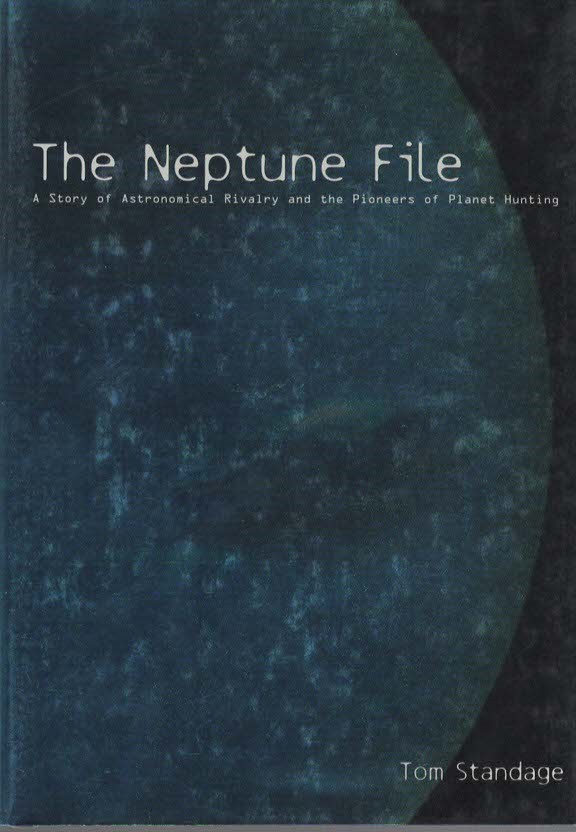
The Neptune File is the first full account of the dramatic events surrounding the eighth planet's discovery, and the story of two remarkable men who were able to "see" on paper what astronomers looking through telescopes for more than 200 years had overlooked.
On June 26, 1841, John Couch Adams, a brilliant young mathematician at Cambridge University, chanced upon a report by England's Astronomer Royal, George Airy, describing unsuccessful attempts to explain the mystifying orbital behavior of the planet Uranus, discovered 65 years earlier. Adams theorized that Uranus's orbit was being affected by the gravitational pull of another, as-yet-unseen planet. Furthermore, he believed that he did not need to see the planet to know where it was. Four years later, his daring mathematical calculations pinpointed the planet's location, but Airy failed to act on them―a controversial lapse that would have international repercussions.
Soon after Adams's "proof," a rival French astronomer, Urbain Le Verrier, also calculated the planet's position, and the race was on to actually view it. Found just where Adams and Le Verrier had predicted, the planet was named Neptune―and as the first celestial object located through calculation rather than observation, its discovery pioneered a new method for planet hunting.
Drawing on long-lost documents in George Airy's Neptune scrapbook, which resurfaced mysteriously at an observatory in Chile in 1999, The Neptune File is a crackling good human drama and a fascinating exploration of the science that underpins planetary astronomy. And the tale continues to unfold, as Tom Standage relates: Since 1995, astronomers have discovered more than 40 planets outside our solar system, opening an intriguing window on the universe. Yet none of these planets have ever been seen. Their discovery―and the history of science―owes much to the two men who unlocked the secret to locating unseen new worlds.
Tom Standage is technology editor at The Economist magazine and the author of four history books, "A History of the World in Six Glasses" (2005), "The Turk" (2002), "The Neptune File" (2000) and "The Victorian Internet" (1998), two of which have been serialized as "Book of the Week" on Radio 4. "The Victorian Internet was made into a Channel 4 documentary, "How The Victorians Wired the World". Tom has previously covered science and technology for a number of newspapers and magazines, including The Guardian, The Daily Telegraph, Wired and Prospect. He holds a degree in engineering and computer science from Oxford University, and is the least musical member of a musical family. He is married and lives in Greenwich, London, with his wife and daughter.