About this Item
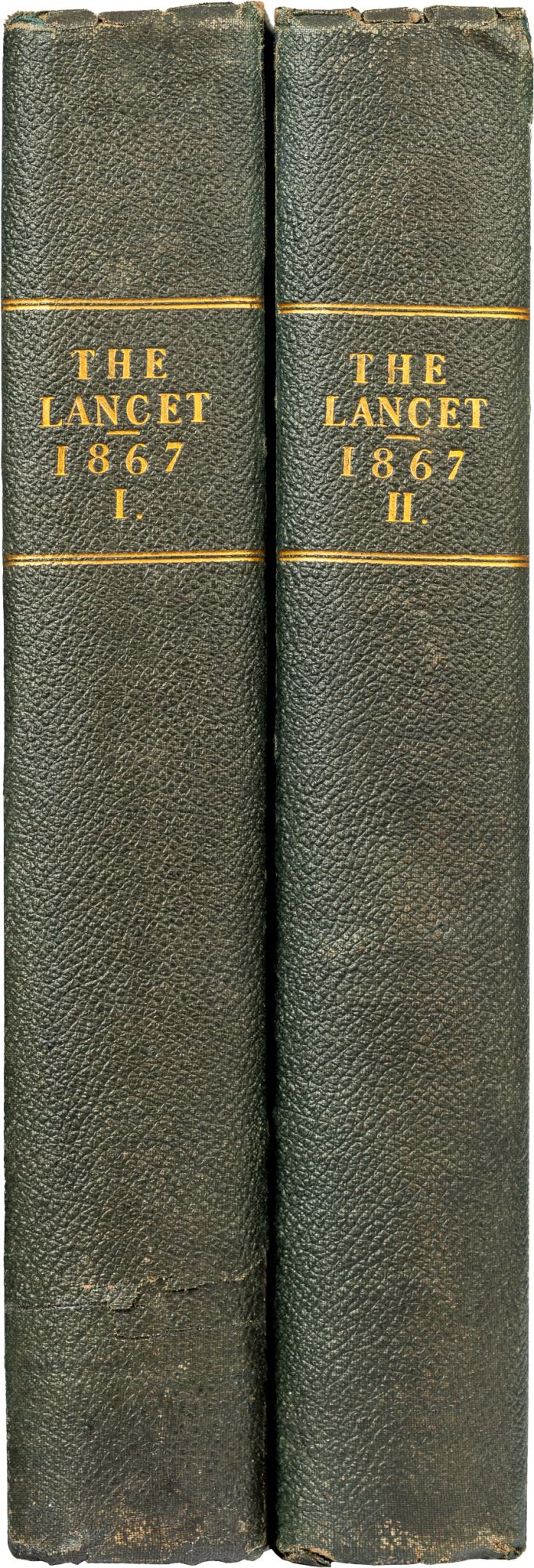
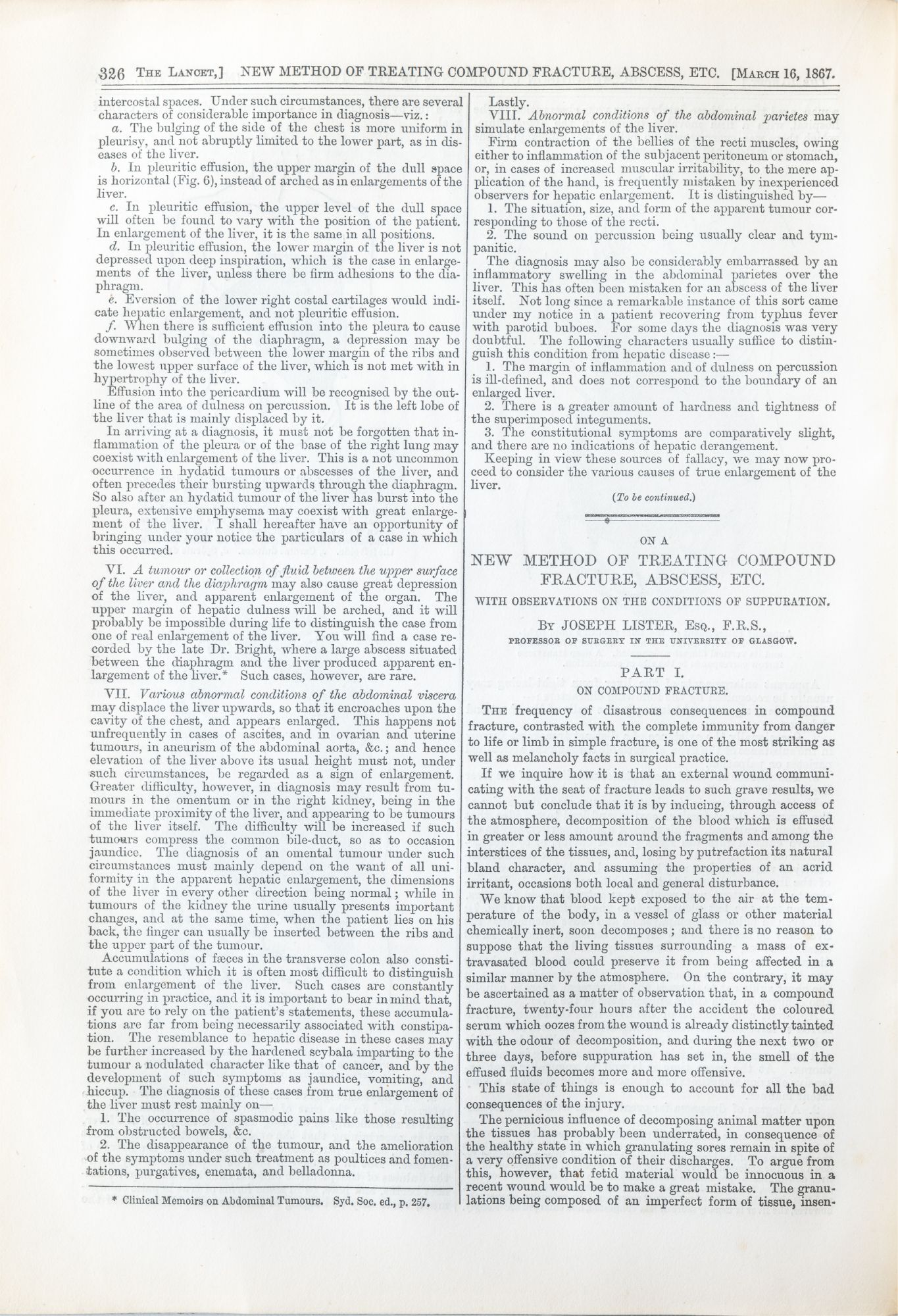
2 vols., 4to (281 x 201mm), pp. 818; 826. the first appearances in print of Lister s seminal papers on antiseptic surgery. Contemporary cloth, splits to the cloth of the spine but holding, spine ends with small chips, library blind stamps on the title pages, else very good. Complete volumes, not extractions. Vol. I contains four of the five parts of Lister s "On a New Method of Treating Compound Fractures, Abscess, etc.," pp. 326 329, 357 359, 387 389, and 507 509. Vol. II contains the fifth part, pp. 95 96, as well as Lister s second article, "On the Antiseptic Principle in the Practice of Surgery," pp. 353 356, and his third article, "The Antiseptic System of Treatment in Surgery," pp. 668 669. Refs: PMM 316c (the first five-part article); Grolier, 100 Books Famous in Medicine, 75 (first article); Dibner, Heralds of Science, 133 (second and third articles); Norman 1367 (second and third articles). Ex-Hartford Medical Society Library with their stamp. As head of the surgical wards at Glasgow's Royal Infirmary, Lister confronted postoperative mortality rates approaching one in two, with most deaths attributable to gangrene, erysipelas, septicemia, and other hospital-acquired infections. Surgical intervention in this period was so tightly bound to the risk of sepsis that amputation was often preferred to attempts at conservative repair of compound fractures. Prevailing efforts to reduce infection focused on cleanliness, ventilation, and the dispersal of "miasmatic" air, under the assumption that putrefaction and disease arose spontaneously from decaying organic matter rather than from specific living agents. Lister's conceptual breakthrough derived from his engagement with Louis Pasteur's experimental work on fermentation and putrefaction, which demonstrated that these processes were caused by airborne microorganisms rather than spontaneous generation. Pasteur's germ theory of fermentation supplied the theoretical framework Lister required to reconceive wound suppuration as a biologically mediated process analogous to fermentation: in both cases, the action of living organisms initiated and sustained the destructive changes observed. If such organisms could be excluded or destroyed, Lister reasoned, putrefaction in wounds and with it the systemic complications of sepsis might be prevented. To realize this principle in practice, Lister adopted carbolic acid (phenol) as an antiseptic agent after noting its use in sewage treatment to neutralize odor and putrefaction. He adapted this chemical to clinical use in the form of carbolic-soaked dressings and sprays, applying them first to cases of compound fracture. In his initial series, he reported that 9 of 11 such cases recovered without the development of putrefactive infection, an outcome unparalleled in contemporary surgical experience and one that immediately distinguished his method from earlier hygienic reforms. He subsequently extended the antiseptic regimen to the treatment of abscesses and other wounds, refining both technique and indications in the articles gathered here. Among the observations Lister recorded, two have particular theoretical importance. First, he showed that a carbolized blood clot, protected from contamination, could become organized into living tissue through the ingrowth of cells and capillaries from adjacent structures, thereby functioning as a physiological dressing rather than as a focus of putrefaction. Second, he demonstrated that sequestra of dead bone in an aseptic wound could be gradually absorbed by surrounding granulation tissue, obviating the need for extensive surgical removal. These findings revealed intrinsic reparative capacities that infection had previously obscured and helped to reconfigure surgical judgments about what tissues and limbs could be preserved. The antiseptic principle articulated in these papers initiated a fundamental transformation in operative surgery and hospital practice. Lister's chemical antisepsis provided the tem.
Seller Inventory # 808
Contact seller
Report this item