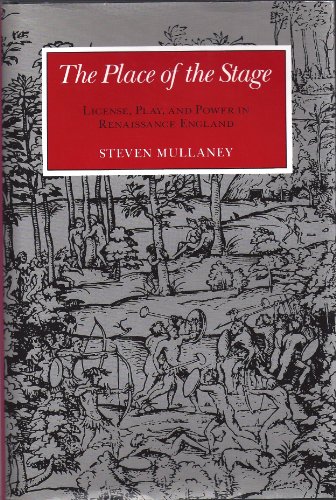
Synopsis
In this richly textured multidisciplinary work, Steven Mullaney examines the cultural situation of popular drama in Elizabethan and Jacobean England. Relying upon a dynamic model of cultural production, Mullaney defines an original and historically grounded perspective on the emergence of popular theater and illustrates the critical, revisionary role it played in the symbolic economy of Renaissance England.
Combining literary, historical, and broadly conceived cultural analysis, he investigates, among other topics, the period's exhaustive "rehearsal" of other cultures and its discomfiting apprehensions of the self; the politics of vanished forums for ideological production such as the wonder-cabinet and the leprosarium; the cultural poetics of royal entries; and the incontinent, uncanny language of treason. As Mullaney demonstrates, Shakespearean drama relied upon and embodied the marginal license of the popular stage and, as a result, provides us with powerful readings of the shifting bases of power, license, and theatricality in Elizabethan and Jacobean England.
"A major study, not merely of selected Shakespearean plays but of the very conditions of the possibility of Renaissance drama." --Louis Montrose, University of California, San Diego
"Mullaney's rich and engaged reading of the place of Shakespeare's stage represents the texture of early modern life and its cultural productions in the vivid tradition of annales history and brilliantly exemplifies his theoretical call for a poetics of culture." -- Shakespeare Quarterly
"Mullaney marshals an impressive range of cultural representations which, taken together, will undoubtedly force a reconsideration of the semiotics of the Elizabethan stage." --Times Higher Education Supplement
". . . something of a dramatic feat in cultural studies: literary critic Mullaney calls in a cast ranging from Clifford Geertz and Pierre Bourdieu to Raymond Williams, Mary Douglas, and Michel Foucault." --Contemporary Sociology
Steven Mullaney is Associate Professor of English at the University of Michigan.
Reviews
The drama is the most social of the arts, depending upon physical space, audience, and social factors for its existence. It is no surprise, therefore, that the most successful criticism approaches theater the way Barber and Mullaney do: as historical artifact. Barber is the better known, having authored the classic Shakespeare's Festive Comedy (1959); the present volume is based on his papers and examines three early Elizabethan tragedies"Tamburlaine" and "Dr. Faustus" by Marlowe and "The Spanish Tragedy" by Kyd. Particularly interested in locating these plays in the unstable religious atmosphere of the late 16th century, Barber ably demonstrates his understanding of the social, historical, and economic factors that defined the era. Mullaney takes the novel approach of examining the theater in light of London topography; the title thus refers to the physical location of the playhouses as well as the social importance of the theater. Mullaney points out that the prejudice that forced the great theaters of the age to operate outside the city walls encouraged a drama that was radical and iconoclastichence its greatness. Mullaney's argument is fascinating and thought-provoking, convincingly presented. James Stephenson, Catholic Univ., Washington, D.C.
Copyright 1987 Reed Business Information, Inc.
"About this title" may belong to another edition of this title.