About this Item
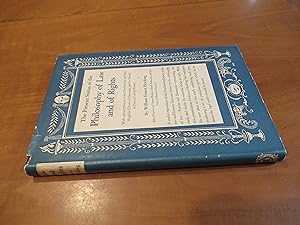
Ix, 97 Pp. Blue Cloth, Gilt. First Printing, 1926 . An Attempt At A Rational Approach To Law With The Emergence Of Popular Over Sovereign Law. Very Near Fine, Gilt Brilliant. Dust Jacket With Slight Usage, Three Tiny Edge Chips, Price Clipped. Per Wikipedia, William Ernest Hocking (1873 ?1966) Was An American Idealist Philosopher At Harvard University. He Continued The Work Of His Philosophical Teacher Josiah Royce (The Founder Of American Idealism) In Revising Idealism To Integrate And Fit Into Empiricism, Naturalism And Pragmatism. He Said That Metaphysics Has To Make Inductions From Experience: "That Which Does Not Work Is Not True." His Major Field Of Study Was The Philosophy Of Religion, But His 22 Books Included Discussions Of Philosophy And Human Rights, World Politics, Freedom Of The Press, The Philosophical Psychology Of Human Nature; Education; And More. In 1908 He Was Called To Yale, Where He Served As An Assistant Professor And Published His First Major Work, The Meaning Of God In Human Experience (1912). In 1914 Hocking Returned To Harvard, Where He Eventually Became Alford Professor Of Natural Religion, Moral Philosophy And Civil Polity. Returning To Harvard After The War, Hocking Made The Rest Of His Career There. He Led A Highly Influential Study Of Missions In Mainline Protestant Churches In 1932. The Commission's Report, Entitled Re-Thinking Missions: A Laymen's Inquiry After One Hundred Years (1932) And Known As The "Hocking Report," Reflected Changing Ideas About The Role Of Western Missionaries In Other Cultures, And Generated Fierce Debate. Commission Members Traveled To Asian Cities To Meet Missionaries And Local People. While In China, Hocking Consulted With Pearl S. Buck, Who Was Developing A Similar Critique Of Missions And Who Later Threw Her Support Behind The Commission's Report. The Commission Recommended A Greater Emphasis On Education And Welfare, Transfer Of Power To Local Groups, Less Reliance On Evangelizing, With Respectful Appreciation For Local Religions. A Recommended Related Goal Was The Transition Of Local Leadership And Institutions. From 1920 To The Late-1930S, Hocking Was A Regular Lecturer At The Naval War College In Newport, Rhode Island, Where He Lectured On "Morale," "Psychology," And "Leadership. Influenced By His Visit To China, Hocking Published A Characteristically Open Minded Study Of The Twelfth-Century Chinese Philosopher Zhu Xi. He Argued That Zhu Xi's Thought Was "Scientific," Which Not All European Philosophers Could Claim, And Therefore Had Something To Teach Westerners About Democracy. In 1936, Hocking Was Invited To Give The Hibbert Lectures At Oxford And Cambridge Universities In England. These Reflected His Thinking About The Relation Of Christianity To Other World Religions, As He Had Begun To Support A Universal Religion. Hocking Thought The Important Elements Were ?A Belief In Obligation, In A Source Of Things Which Is Good, In Some Kind Of Permanence For What Is Real In Selfhood, And In The Human Aspect Of Deity." He Pins His Hope More On The Common People Throughout The World Than On The Theologians. In Political Philosophy, Hocking Claimed That Liberalism Must Be Superseded By A New Form Of Individualism In Which The Principle Is: "Every Man Shall Be A Whole Man."[12] He Believed That Humans Have Only One Natural Right: "An Individual Should Develop The Powers That Are In Him. The Most Important Freedom Is "The Freedom To Perfect One's Freedom.? Perhaps Hocking's Most Important Contribution To Philosophy Is "Negative Pragmatism," Which Means That What "Works" Pragmatically Might Or Might Not Be True, But What Does Not Work Must Be False. Hocking's Criterion Was Corroborated By Richard Feynman, Who Stated That Anything Described As True ". Could Never Be Proved Right, Because Tomorrow's Experiment Might Succeed In Proving Wrong What You Thought Was Right ." And ". If It Disagrees With Experiment, It Is Wrong.?.
Seller Inventory # 056317
Contact seller
Report this item