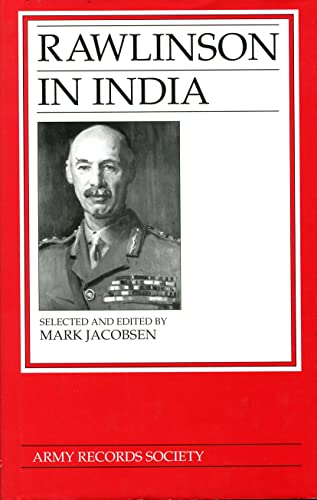
RAWLINSON IN INDIA
Mark Jacobsen (Editor)
Sold by Amazing Book Company, Liphook, United Kingdom
AbeBooks Seller since October 25, 2007
New - Hardcover
Condition: New
Ships from United Kingdom to U.S.A.
Quantity: 1 available
Add to basketSold by Amazing Book Company, Liphook, United Kingdom
AbeBooks Seller since October 25, 2007
Condition: New
Quantity: 1 available
Add to basketThis copy is in new, unmarked condition bound in red cloth covered boards with bright gilt titling to the spine. This copy is bright, tight, white and square. The unclipped dust wrapper is lightly sunned to the spine and has a tiny 'nibble' to the bas of the spine but is still in fine condition. International postal rates are calculated on a book weighing 1 Kilo, in cases where the book weighs more than 1 Kilo increased postal rates will be quoted, where the book weighs less then postage will be reduced accordingly. General Lord Rawlinson commanded the Army in India from 1920 until his death in 1925.He went to India in late 1920 hoping to reshape the Indian Army along lines indicated by the Great War. Rawlinson hoped to introduce tanks and armoured cars in India and to provide for the Royal Air Force. Armed with the Esher report, which sought to integrate the Indian military with Imperial forces, Rawlinson had good reason to be optimistic. The Mesopotamian campaign had demonstrated the Army?s shortcomings in sustained operations even east of Suez. To those accustomed to ?thinking imperially? a properly constituted and led India Army offered immense advantages in policing the new territories now to be administered. Instead, he encountered political and financial obstacles that baulked him at nearly every turn. His arrival coincided with the advent of limited representative government under the Montagu-Chelmsford reforms and the irruption of Gandhian civil disobedience. The aftermath of the third Afghan War (1919) kept the North-West Frontier on the boil until 1923, and the establishment of the Soviet Union brought back the Russian threat. Internally, the Indian Army faced serious disaffection as a result not only of Gandhi but of the Akali (?true-path?) Sikh movement in the most heavily recruited districts of the Punjab. During the Great War the Indian Army had recruited heavily among the favoured 'martial races' but afterwards had to demobilize these soldiers in unsettled conditions. Ultimately, the need to accommodate Indian political opinion and to maintain forces to meet potential threats internal and external scuttled Rawlinson's ambitions. This collection of Rawlinson?s Indian documents uses his papers at the National Army Museum and also makes abundant use of Rawlinson?s letters and correspondence with General Sir Archibald Montgomery, Field Marshal Sir Henry Wilson, and the Earl of Derby. The book contributes to our understanding of the Indian Army but also sheds new light on the political difficulties faced by India's British rulers in the twilight of the Raj. Ref A5 6.
Seller Inventory # 034862
"About this title" may belong to another edition of this title.
Buyer pays postage - quotes given. Refunds given within 14 days of purchase on books returned as sent.
Shipping costs are based on books weighing 2.2 LB, or 1 KG. If your book order is heavy or oversized, we may contact you to let you know extra shipping is required.
| Order quantity | 30 to 50 business days | 5 to 10 business days |
|---|---|---|
| First item | US$ 40.67 | US$ 48.08 |
Delivery times are set by sellers and vary by carrier and location. Orders passing through Customs may face delays and buyers are responsible for any associated duties or fees. Sellers may contact you regarding additional charges to cover any increased costs to ship your items.