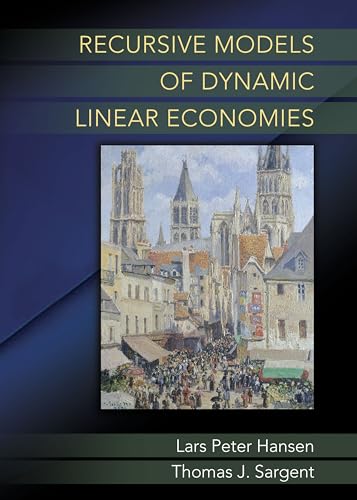
Recursive Models of Dynamic Linear Economies (The Gorman Lectures in Economics, 6)
Hansen, Lars Peter
ISBN 10: 0691042772 ISBN 13: 9780691042770
Published by Princeton University Press, 2013
New
hardcover
From
Russell Books, Victoria, BC, Canada
Seller rating 4 out of 5 stars

Heritage Bookseller
AbeBooks member since 1996
This specific item is no longer available.
About this Item
Description:
Special order direct from the distributor. Seller Inventory # ING9780691042770
Synopsis:
A guide to the economic modeling of household preferences, from two leaders in the field
A common set of mathematical tools underlies dynamic optimization, dynamic estimation, and filtering. In Recursive Models of Dynamic Linear Economies, Lars Peter Hansen and Thomas Sargent use these tools to create a class of econometrically tractable models of prices and quantities. They present examples from microeconomics, macroeconomics, and asset pricing. The models are cast in terms of a representative consumer. While Hansen and Sargent demonstrate the analytical benefits acquired when an analysis with a representative consumer is possible, they also characterize the restrictiveness of assumptions under which a representative household justifies a purely aggregative analysis.
Hansen and Sargent unite economic theory with a workable econometrics while going beyond and beneath demand and supply curves for dynamic economies. They construct and apply competitive equilibria for a class of linear-quadratic-Gaussian dynamic economies with complete markets. Their book, based on the 2012 Gorman lectures, stresses heterogeneity, aggregation, and how a common structure unites what superficially appear to be diverse applications. An appendix describes MATLAB programs that apply to the book's calculations.
About the Author: Lars Peter Hansen is the David Rockefeller Distinguished Service Professor at the University of Chicago, where he is also the research director of the Becker Friedman Institute. Thomas J. Sargent is professor of economics at New York University and a senior fellow at the Hoover Institution at Stanford University. His books include Rational Expectations and Inflation and The Conquest of American Inflation (both Princeton). Hansen and Sargent are the coauthors of Robustness (Princeton). Sargent was awarded the Nobel Prize in economics in 2011 and Hansen received it in 2013.
"About this title" may belong to another edition of this title.
Bibliographic Details
Title: Recursive Models of Dynamic Linear Economies...
Publisher: Princeton University Press
Publication Date: 2013
Binding: hardcover
Condition: New
Edition: 1st Edition.
Top Search Results from the AbeBooks Marketplace

Stock Image
Recursive Models of Dynamic Linear Economies (The Gorman Lectures in Economics)
Published by
Princeton University Press, 2013
ISBN 10: 0691042772
ISBN 13: 9780691042770
New
Hardcover
Seller: Labyrinth Books, Princeton, NJ, U.S.A.
Seller rating 4 out of 5 stars
Condition: New. Seller Inventory # 158683
Seller Image
RECURSIVE MODELS OF DYNAMIC LINEAR ECONOMIES THE GORMAN LECTURES IN ECONOMICS
Published by
PRINCETON UNIVERSITY PRESS, 2014
ISBN 10: 0691042772
ISBN 13: 9780691042770
New
Hardcover
Seller: Antártica, Madrid, M, Spain
Seller rating 5 out of 5 stars

Cartoné (tapa dura cartón). Condition: New. Dust Jacket Condition: Nuevo. 01. LIBRO. Seller Inventory # 557468
Stock Image
Recursive Models of Dynamic Linear Economies (The Gorman Lectures in Economics)
Published by
Princeton University Press, 2014
ISBN 10: 0691042772
ISBN 13: 9780691042770
Used
Hardcover
Seller: Anybook.com, Lincoln, United Kingdom
Seller rating 5 out of 5 stars
Condition: Good. This is an ex-library book and may have the usual library/used-book markings inside.This book has hardback covers. In good all round condition. Dust jacket in good condition. Please note the Image in this listing is a stock photo and may not match the covers of the actual item,1000grams, ISBN:9780691042770. Seller Inventory # 3716211
Buy Used
US$ 60.94
US$ 17.93 shipping
Ships from United Kingdom to U.S.A.
Ships from United Kingdom to U.S.A.
Quantity: 1 available
Stock Image
Recursive Models of Dynamic Linear Economies (The Gorman Lectures in Economics)
Published by
Princeton University Press, 2013
ISBN 10: 0691042772
ISBN 13: 9780691042770
New
Hardcover
Seller: Lucky's Textbooks, Dallas, TX, U.S.A.
Seller rating 5 out of 5 stars
Condition: New. Seller Inventory # ABLIING23Feb2416190101220
Seller Image
Recursive Models of Dynamic Linear Economies
Published by
Princeton University Press, 2013
ISBN 10: 0691042772
ISBN 13: 9780691042770
New
Hardcover
Seller: GreatBookPrices, Columbia, MD, U.S.A.
Seller rating 5 out of 5 stars
Condition: New. Seller Inventory # 401281-n
Seller Image
Recursive Models of Dynamic Linear Economies
Published by
Princeton University Press, 2013
ISBN 10: 0691042772
ISBN 13: 9780691042770
Used
Hardcover
Seller: GreatBookPrices, Columbia, MD, U.S.A.
Seller rating 5 out of 5 stars
Condition: As New. Unread book in perfect condition. Seller Inventory # 401281
Seller Image
Recursive Models of Dynamic Linear Economies
Published by
Princeton University Press, US, 2013
ISBN 10: 0691042772
ISBN 13: 9780691042770
New
Hardcover
Seller: Rarewaves USA, OSWEGO, IL, U.S.A.
Seller rating 5 out of 5 stars
Hardback. Condition: New. A common set of mathematical tools underlies dynamic optimization, dynamic estimation, and filtering. In Recursive Models of Dynamic Linear Economies, Lars Peter Hansen and Thomas Sargent use these tools to create a class of econometrically tractable models of prices and quantities. They present examples from microeconomics, macroeconomics, and asset pricing. The models are cast in terms of a representative consumer. While Hansen and Sargent demonstrate the analytical benefits acquired when an analysis with a representative consumer is possible, they also characterize the restrictiveness of assumptions under which a representative household justifies a purely aggregative analysis. Hansen and Sargent unite economic theory with a workable econometrics while going beyond and beneath demand and supply curves for dynamic economies. They construct and apply competitive equilibria for a class of linear-quadratic-Gaussian dynamic economies with complete markets. Their book, based on the 2012 Gorman lectures, stresses heterogeneity, aggregation, and how a common structure unites what superficially appear to be diverse applications.An appendix describes MATLAB programs that apply to the book's calculations. Seller Inventory # LU-9780691042770
Seller Image
Recursive Models of Dynamic Linear Economies
Published by
Princeton University Press, 2013
ISBN 10: 0691042772
ISBN 13: 9780691042770
New
Hardcover
Seller: GreatBookPricesUK, Woodford Green, United Kingdom
Seller rating 5 out of 5 stars
Condition: New. Seller Inventory # 401281-n
Buy New
US$ 87.69
US$ 20.07 shipping
Ships from United Kingdom to U.S.A.
Ships from United Kingdom to U.S.A.
Quantity: 1 available
Seller Image
Recursive Models of Dynamic Linear Economies
Published by
Princeton University Press, US, 2013
ISBN 10: 0691042772
ISBN 13: 9780691042770
New
Hardcover
Seller: Rarewaves USA United, OSWEGO, IL, U.S.A.
Seller rating 5 out of 5 stars
Hardback. Condition: New. A common set of mathematical tools underlies dynamic optimization, dynamic estimation, and filtering. In Recursive Models of Dynamic Linear Economies, Lars Peter Hansen and Thomas Sargent use these tools to create a class of econometrically tractable models of prices and quantities. They present examples from microeconomics, macroeconomics, and asset pricing. The models are cast in terms of a representative consumer. While Hansen and Sargent demonstrate the analytical benefits acquired when an analysis with a representative consumer is possible, they also characterize the restrictiveness of assumptions under which a representative household justifies a purely aggregative analysis. Hansen and Sargent unite economic theory with a workable econometrics while going beyond and beneath demand and supply curves for dynamic economies. They construct and apply competitive equilibria for a class of linear-quadratic-Gaussian dynamic economies with complete markets. Their book, based on the 2012 Gorman lectures, stresses heterogeneity, aggregation, and how a common structure unites what superficially appear to be diverse applications.An appendix describes MATLAB programs that apply to the book's calculations. Seller Inventory # LU-9780691042770
Seller Image
Recursive Models of Dynamic Linear Economies
Published by
Princeton University Press, 2014
ISBN 10: 0691042772
ISBN 13: 9780691042770
New
Hardcover
Seller: moluna, Greven, Germany
Seller rating 4 out of 5 stars
Gebunden. Condition: New. Demonstrates the analytical benefits acquired when an analysis with a representative consumer is possible, they also characterize the restrictiveness of assumptions under which a representative household justifies a purely aggregative analysis.A common . Seller Inventory # 5948052
Buy New
US$ 88.10
US$ 57.40 shipping
Ships from Germany to U.S.A.
Ships from Germany to U.S.A.
Quantity: Over 20 available