Synopsis
The exploration of space represents a cultural shift greater than the invention of agriculture or the arrival of the Industrial Revolution. It marks a biological leap as significant as the wriggling of the first fish onto land or the passage of the first primate from the jungle to the savannah. For the first time in human history, the sheer force of our curiosity has carried us beyond our own world.
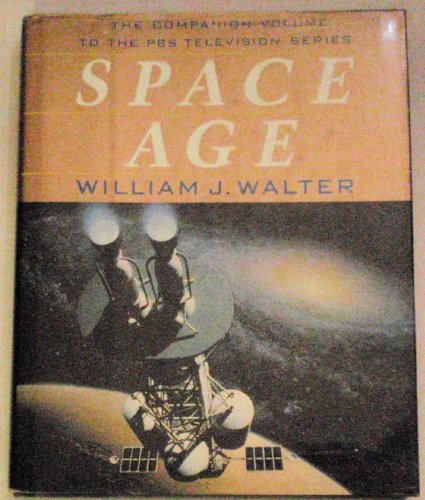
Space Age is the companion book to the extraordinary six-part PBS television series produced by WQED/Pittsburgh in association with the National Academy of Sciences. Written by journalist and filmmaker William J. Walter, it takes readers on an exciting and unexpected journey into the past and maps out strange and amazing possibilities for the future.
It begins by telling the stories of the extraordinary rocket pioneers who made the primal dream of exploring the stars possible: Konstantin Tsiolkovsky, a deaf, small-town Russian schoolteacher, who in 1898 first calculated how to launch a rocket beyond Earth; Robert Goddard, the secretive and determined New England physics professor, who had the personality of a parson but the mind of a mad adventurer; and Hermann Oberth, a high school math teacher from Transylvania, whose failed effort to build a rocket for a publicity stunt in the 1920s became the first in a long line of rockets that led to the Saturn V booster - the mammoth ship that sent American astronauts to the moon forty years later.
Space Age reveals how the pragmatic world of politics unexpectedly became linked with the dream-driven hopes of the old rocket pioneers; how Hitler's madness financed the development of the first true rocket designed by Werner von Braun; how Russia and America's mutual paranoia fueled not only the cold war, but the spectacular way in which both nations chose to wage it - through a space race that held the world breathless. The progeny of that competition was Sputnik, Mercury, and Apollo, which led us to the moon, and whose legacy enabled us to study other worlds and continues to lay the foundations for human outposts that will be built beyond Earth in the future.
At the same time it created the spy satellite, the communications satellite, and other space-borne instruments that now predict the weather and explore the intricate living systems that make up our planet. These orbiting sentinels have embedded in us a kind of robotic telepathy, an invisible grid of information that has already made the "global village" a reality, and brought war and the fall of entire societies into our living rooms, live.
Finally, Space Age looks into the future - to the tremendous challenge of mounting a human mission to Mars, and the surprising evolutionary possibilities that will follow in the wake of interplanetary and intergalactic exploration. Is it possible that we will learn something of our own origins as we search for evidence of life on Mars?
Reviews
A companion volume to an upcoming PBS series, this book attempts to provide a new perspective on recent advances in space, showing that space technology and space exploration have forever changed our view of the cosmos and of ourselves. As a general introduction, it succeeds quite well. Walter recaps the role of early Apollo photographs of earth in raising our ecological consciousness and of later, unstaffed planetary probes in reinforcing awareness of the fragility of our planet. How applications satellites have made a reality of the global village through worldwide communications, how weather satellites have revolutionized severe storm forecasting, and how earth resources satellite data are being used to manage the earth's finite resources--all are succinctly explained, as is the crucial role played by military spy satellites in keeping the Cold War cold. Walter concludes with a look ahead at plans for staffed lunar outposts, trips to Mars, and the economic potential of a space-based economy. The TV series may create demand, but libraries already owning the similar Blueprint for Space: Science Fiction to Science Fact ( LJ 2/15/92) may wish to skip this work. Previewed in Prepub Alert, LJ 6/1/92.
- Thomas J. Frieling, Bain bridge Coll., Ga .
Copyright 1992 Reed Business Information, Inc.
"About this title" may belong to another edition of this title.