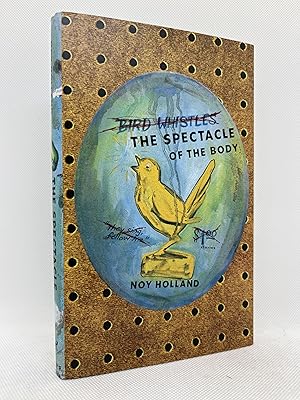
Synopsis
A debut collection of short stories transforms the English language to produce intriguing effects, in tales that chronicle her mother's long, agonizing death
Reviews
Strange, glittering, incantatory language marks Holland's debut short-fiction collection. These odd, occasionally impenetrable pieces were not written for narrative addicts; though certain events do occur, they are seen only hazily through a mesmerizing--and sometimes fustian--web of words and style. In "Orbit," a brother and sister offer alternating impressionistic accounts of the summer when their father abandoned their dying mother, leaving them alone on the family farm. Looping, cadenced sentences ("I did not have shoes. I did not have Bingo with me going there or coming back, and coming back I came by foot and I did not have shoes.") convey the anarchic rhythms of this macabre idyll. "Delicious," a disturbing exploration of the undercurrents of--among other things--the relationship between a waitress and a restaurant customer, is narrated almost entirely in wickedly accurate restaurant lingo. The brief but chilling "Winter Bodies" concerns a ritual act--possibly a highly personal sort of last rite--carried out by a man upon the drugged-out and/or diseased body of his lover. "The Change in Union City," one of the collection's more accessible stories, is the chronicle of the declining fortunes of a small town and its most colorful, vital inhabitant. If they can get past the gothic excess, sophisticated readers will enjoy the challenge of these provocative, nearly hypnotic stories.
Copyright 1994 Reed Business Information, Inc.
Holland (Writing/Univ. of Florida) uses a fluttery and potent style in this debut collection of short stories, but she often indulges in excesses of imagery and language. Most of her characters appear to be Southerners--occasionally verging on Faulknerian caricatures--and Holland upholds the region's tradition with tales that contain some fairly gothic behavior. In ``Absolution'' a woman who has been crowned banana queen describes her relationships with her lover (``he ain't the hitching kind'') and her mother, who ``sometimes...wants my mouth on her breast, like when I was her child.'' A man shaves off all of his bedridden wife's body hair in ``Winter Bodies''; the waitress narrator of ``Delicious'' sees a customer chew all of his food, then remove it from his mouth and replace it on his plate. There's a great deal of illness and dying, as well, most of it slow and painful. A talkative man loses his ability to speak after a car accident in ``The Change in Union City.'' Being hand-fed Ethiopian food triggers memories of feeding an elderly father for the narrator of ``Amharic.'' The lengthy and problematic story ``Orbit,'' which shows a brother and sister caring for their sick mother to the best of their abilities after their father leaves, brings out the best and the worst in Holland's writing. It contains wonderful images--attempting to coerce captured turtles from their shells, the siblings ``try to pry them out with kitchen knives and pliers, to burn them out with candles, mute things, toothless''-- but in the end they pile up without connecting much, and it becomes difficult to locate the narrative within all the symbolism. An intriguing new voice, at the moment a little too enamored of showy cadenzas and neglectful of basic melody. -- Copyright ©1994, Kirkus Associates, LP. All rights reserved.
Eight short stories and one long one make up Holland's first collection. Her style is spare; at the same time, she has a sheer eloquence as piercing as the brilliance of polished metal caught in sunshine. Men and women, parents and children: these common but not always so ordinary relationships are Holland's playing fields. Characters' nerves are always close to the surface, always threatening to unravel. "Orbit" is the collection's long story, really a novella. In alternating points of view (its length and compass allow this usual violation in short story technique to work), it tells of what some kids are up to--"we broke rules"--when their father has left and their mother is dying. It has a fundamental poignancy couched in humor, characteristic of all the stories. That's even true of the three-page "Winter Bodies," in which a man is shaving, sheering, and scissoring all the hair off his dying mother's body. (A dying mother is not a subject limited to these two stories, either.) Initially we think it's funny, but then we're seriously moved. Even readers who enjoy more "maximalism" than these stories offer will be impressed by their keen tellingness about human nature. Brad Hooper
In this debut work of fiction, a young author from Alabama is able to capture with startling clarity the lives of the characters in her stories. Her nine stories deal honestly with everyday life situations, especially those that are agonizing. Holland is especially dazzling in stories based on her own mother's long, painful death, as in "Orbit," which eloquently details all the hardships a family must go through: "I could not hear her. I saw her talking. Mother for hours made sounds with her mouth in a voice not as loud as breathing. I leaned my head close. I felt her breathing. She was saying thank you. All along, she was saying thank you." Holland, who grew up in Mexico and Kentucky, effectively portrays a wide range of different characters. Her enchanting prose style and her realism make this suitable for all libraries.
Vicki Cecil, Johnson Cty. Lib., Greenwood, Ind.
Copyright 1994 Reed Business Information, Inc.
"About this title" may belong to another edition of this title.