Synopsis
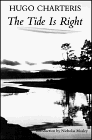
This remarkable novel, suppressed in 1957 and published by Dalkey Archive for the first time, is concerned with a day in the life of a stagnant, aristocratic Scottish family in the 1950s. As the family prepares for its annual Christmas dance, old rivalries and tensions flare as John Harling arrives to visit his sister Mary, who has married Duncan Mackean, next in line to inherit the estate left by Colin Mackean, dead two years now, but very much alive in the memory of the current family, presided over by Alan Mackean and his wife Augustine (“Tin”). By the end of this nerve-racking day, John tells his sister that “this life, which you lead here, is incestuous” and that her husband Duncan “is in love with things he should have left―long ago. Soil, place, family, the past―roots . . . One must have courage to travel light today.” That night, Duncan and Alan go out shooting; only one returns alive. The reader, like a visitor, is an outsider who must rely on hints, looks, silences, and unspoken sentences to untangle the web of intrigue that binds this fascinating family. Nicholas Mosley, who knew Charteris at school, tells us that the author of The Tide is Right “in his novels . . . tried to describe the complexity of changing attitudes of class-conscious Britain from the inside . . . he wrote not only of the absurdities and irrelevances typical of the British aristocracy but also of the resilience, the earthiness and even the ruthlessness that would enable it in a modified form to survive.” Charteris deserves to be compared to Waugh, especially in A Handful of Dust―the ironies of primogeniture or high jinks in high places―and The Tide is Right should revive his reputation as one of the most significant of postwar British novelists.
Reviews
This study of a dysfunctional upper-class Scottish family bristles with acid witticisms reminiscent of Evelyn Waugh. London journalist John Harling feels guilty for having encouraged his sister Mary to marry dissolute cad Duncan Mackean. Harling goes to visit the Mackean estate, but Christmas revelry turns to nightmare when Duncan and his aristocratic cousin Alan go out shooting, and only one returns alive. Haunting the clan is the memory of Alan's father, war hero Colin Mackean, dead two years, "a sort of archetypal Highland god-figure." In stylish, quirky, elliptical and lyrically powerful prose, British novelist Charteris (1922-70) cheerfully strips away upper-class poses and pretensions, revealing the jealousies, hang-ups and latent violence lurking beneath the surface. This delectably sardonic novel was withdrawn from publication in 1957 in response to protests by the family on which the protagonists were said to be modeled. It's as fresh as if written yesterday.
Copyright 1991 Reed Business Information, Inc.
This satire on the British aristocracy, originally intended for publication in 1957, was suppressed by an aristocratic family because two of the main characters were modeled after its members. It portrays a day in the life of the Mackean family on and near their Scottish estate. Plot and characters as well as the objective "camera" style of writing put one in mind of Jean Renoir's film, The Rules of the Game. It is well written, but as a book intended for the 1950s reminiscent of British satire like Waugh's it will probably not have wide appeal. Notes on slang of the day would have made it more accessible. A necessary book, however, for larger modern British collections.
- Judy Mimken, Cardinal Strich Coll., Milwaukee
Copyright 1991 Reed Business Information, Inc.
"About this title" may belong to another edition of this title.