About this Item
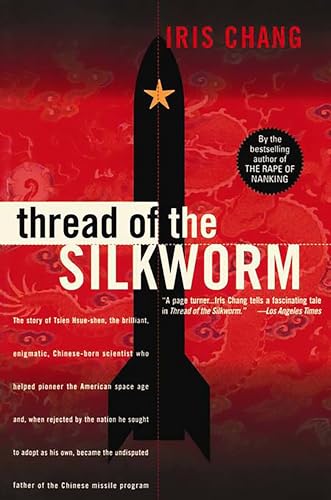
xvii, [1], 329, [3] pages. Notes. Index. Cover has minor wear and soiling. The definitive biography of Tsien Hsue-Shen, the pioneer of the American space age who was mysteriously accused of being a communist, deported, and became, to America's continuing chagrin, the father of the Chinese missile program. Iris Shun-Ru Chang (March 28, 1968 - November 9, 2004) was an American journalist, author and political activist. She is best known for her best-selling 1997 account of the Nanking Massacre, The Rape of Nanking, and in 2003, The Chinese in America: A Narrative History. Chang is the subject of the 2007 biography Finding Iris Chang, and the 2007 documentary film Iris Chang: The Rape of Nanking starring Olivia Cheng as Iris Chang] The independent 2007 documentary film Nanking was based on her work and dedicated to her memory. Her first book, Thread of the Silkworm tells the life story of the Chinese professor, Qian Xuesen (or Tsien Hsue-shen) during the Red Scare in the 1950s. Qian was one of the founders of NASA's Jet Propulsion Laboratory, and for many years helped the military of the United States debrief scientists from Nazi Germany. He was suddenly accused of being a spy and a member of the Communist Party USA, and was under house arrest from 1950 to 1955. Qian left for the People's Republic of China in 1955. Upon his return to China, Qian developed the Dongfeng missile program, and later the Silkworm missile, which was used by the Iraqi military during its war on Iran and against the United States-led coalitions during the Persian Gulf War and the 2003 invasion of Iraq. Thread of the Silkworm is a 1996 historical nonfiction book by Iris Chang. It tells the story of Tsien Hsue-Shen, a leading aerodynamist who worked with Theodore von Karman and is associated with the Jet Propulsion Lab, was deported amidst the Red Scare, and subsequently became a chief progenitor of the Chinese space program. In 1950 he was suspected as a communist and was deported in 1955 during the Red Scare; afterwards, he joined the Chinese Communist Party, writing an article that "scientifically supported" Mao's Great Leap Forward. He is chiefly remembered for becoming a chief designer of China's missile and satellite programs, among them the book's namesake, the Silkworm missile. Although Chang was unable to interview Tsien because he refused to talk to Americans, she interviewed his son. Chang wrote of Tsien: How stark the contrast between the young Tsien and the old. The young Tsien dreamed of a world of peace and equality. The older Tsien lived in a world governed by regimented hierarchy and helped manufacture the weapons of world destruction. The young Tsien was both Chinese and American, at heart a citizen of two countries. The older Tsien felt alienated by both. Tianyu Fang of the Foreign Policy called the book "perhaps the most comprehensive account of Tsien's life.
Seller Inventory # 86301
Contact seller
Report this item