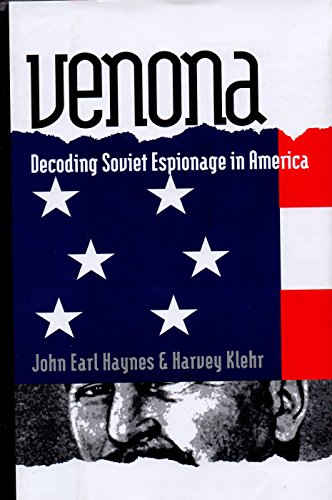
Synopsis
Reveals telegrams to prove Soviets spied in the 1930s and 1940s
Reviews
This first comprehensive analysis of the 3,000 telegrams between Soviet spies in the US and their superiors in Moscow, decoded shortly after WWII, may well, as the authors believe, ``change the way we think about twentieth-century American history.'' The Venona transcripts, while revealed in part to the Soviets by agents like Kim Philby, were one of the most closely guarded US secrets, since the US didnt want the Soviets to understand the full extent of the damage they had sustained. In one of the extraordinary revelations of this book, the authors, Haynes (History/Library of Congress) and Klehr (Politics and History/Emory Univ.) note that Army Chief of Staff Omar Bradley denied President Truman direct knowledge of the project for fear of a leak, while informing him of the substance of the messages. Moreover, the information could not be used in prosecutions of those guilty of espionage. The consequence was the growth of the widespread belief that the very existence of the charges were evidence of anti-Communist paranoia. The authors, who have previously written seminal analyses of Soviet activity in the US (The Soviet World of American Communism, 1998, etc.), use the decrypts to show how extensive Soviet espionage actually was. In addition to the nuclear spies and top agents like Alger Hiss, who presided at the first session of the United Nations, and Harry Dexter White, the number two at the Treasury, the transcripts identify 349 US citizens and other residents who had a covert relationship with Soviet intelligence. There were 11 well-placed spies in the Treasury, 15 in OSS, many in other key departments. In fact, the authors have changed their view of the Communist Party of the US, which they conclude ``was indeed a fifth column working inside and against the United States in the Cold War.'' The reverberations from this cool, balanced, and devastating appraisal will be heard for many years to come. (30 illustrations) -- Copyright ©1999, Kirkus Associates, LP. All rights reserved.
Those who were convinced that the Soviets were spying on us during the 1930s and 1940s were right. Haynes and Klehr have provided the most extensive evidence to date that the KGB had operatives at all levels of American society and government. Where Allen Weinstein and Alexander Vassilievs The Haunted Wood (LJ 11/15/98) provided a peek at Soviet spying, Haynes and Klehr throw open the door, revealing a level of espionage in this country that only the most paranoid had dreamed of. Building on the research for their earlier books, The Secret World of American Communism (LJ 6/1/95) and The Soviet World of American Communism (Yale Univ., 1998), Haynes and Klehr describe the astonishing dimensions of spying reflected in the cable traffic between the United States and Moscow. Venona is the name of the sophisticated National Security Agency project that in 1946 finally broke the Soviet code. This is better than anything John le Carr could produce, because in this case, truth is really stranger than fiction. Highly recommended.Edward Goedeken, Iowa State Univ. Lib., Ames
Copyright 1999 Reed Business Information, Inc.
The Venona Project, a U.S. secret revealed only in 1995, decrypted Soviet intelligence's wartime cable traffic. It purportedly not only exposed an astounding scale of Soviet espionage but also undermined the liberal critique of the postwar Red scare. The Nation irately denounced Venona as a government forgery. The authors systematically recount Venona's references to approximately 350 Soviet spies in U.S. government and industry--some of them highly placed, most notoriously Alger Hiss. The damage wrought by Hiss and others is not yet known, as Venona does not contain the actual documents they stole, but their espionage appears now irrefutable. Apparently U.S. intelligence was aware of that in the 1940s, raising the historical question of whether keeping Venona secret was worth it, given how liberal and conservative vitriol over causes celebres such as Hiss and the Rosenbergs poisoned U.S. politics at the time. Venona may open a fundamental revision of U.S. history and lend foundation to The Haunted Wood by Allen Weinstein and Alexander Vassiliev. Gilbert Taylor
"About this title" may belong to another edition of this title.