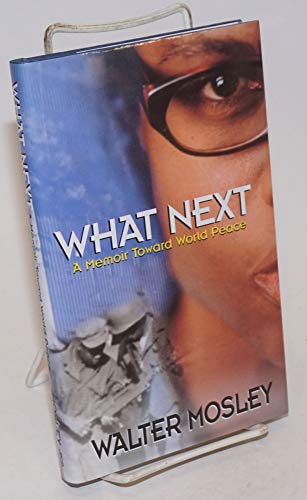
Mosley, like many New Yorkers, has tried to make sense of the events of 9/11--and his own reaction to them. He remembered his father's stories about World War II and how he didn't think of himself as an American until German soldiers shot at him. How did he feel--and how did African Americans feel--about the unfolding debate of what brought America to this tragic juncture. Was the displacement his father felt, a half century ago, still a part of this new generations' experience?
In What Next, Mosley addresses these questions and others, inviting the reader into a dialogue that is brilliantly argued, and poetically concise. What Next offers food for thought and is a call to action for African Americans and freedom loving people everywhere.
This impassioned essay urges black Americans to take the lead in shaping America's response to the September 11 attacks. Mosley, author of the Easy Rawlins mystery series, puts forth a radical critique of U.S. foreign policy, recalling U.S. interventions in Indochina, Central America and the Middle East to assert that America often acts as a "pillager-nation" concerned more with corporate profits and cheap oil than with democracy and human rights; Arab antipathy towards the U.S. is thus more a response to U.S. economic imperialism than to religious or cultural antagonisms. Drawing on memories of his father's struggle against racism, he argues that blacks' experience of racial injustice in the United States obligates them to sympathize with oppressed peoples elsewhere and to understand (although Mosley does not condone) the murderous rage directed at America by many in the Muslim world. He exhorts blacks to take the lead in resisting the current militaristic response to terrorism and to demand that America harmonize its foreign policy with its humanitarian ideals and with the interests of the downtrodden "from Africa to Afghanistan." Interweaving the personal and the polemical, Mosley aims to shock readers out of their moral complacency; "It is up to me," he writes, "to make sure that my dark-skinned brothers and sisters around the world...are not enslaved, vilified, and raped by my desire to eat cornflakes or take a drive." Although his exclusive focus on economic motives somewhat oversimplifies U.S. foreign policy, he raises a compelling and eloquent challenge to America's role in the world.
Copyright 2003 Reed Business Information, Inc.
Mosley, noted for his Easy Rawling mysteries set in black Los Angeles from the 1940s to the 1960s, draws from the roots of his folk experience to challenge black Americans to do their part for world peace. He notes the lack of black engagement or dialogue since 9/11 and asserts that such is a loss for all Americans, if not the world. Mosley draws on the folk wisdom and struggle of his father and grandfather's generations, who came to know a sense of Americanness and freedom denied to previous generations. Mosely argues that it is, in fact, the profound awareness of this nation's flaws that sustains an African American consciousness and provides a more complete perspective that is missing in the American narrative. The black experience of the terror of lynching, Jim Crow, and slavery are experiences to which most of white America is blind. Yet African Americans have lived with a sense of hope and faith in American ideals. Mosley believes that African Americans' sharing this experience benefits the nation and the prospects for world peace. Vernon Ford
Copyright © American Library Association. All rights reserved