About this Item
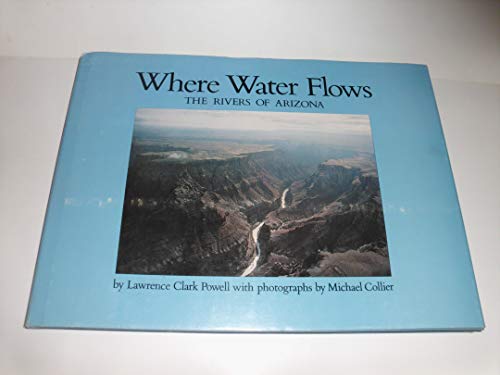
Blue cloth octavo in blue dust jacket (light, sunned spine) and archival mylar wrap; xii, 64 pages, 1 unnumbered leaf of plates: color illustrations; 21 x 29 cm. "If there were one key to the Southwest history and culture, it might well be the river systems of the region," writes Lawrence Clark Powell in his prologue. Concentrating on seven major waterways in Arizona, Powell illustrates the truth of his statement with a multitude of significant facts and ideas about the geography, history, and literature surrounding these rivers. Along with photographer Michael Collier and pilot Christopher Condit, Powell made aerial surveys in a Cesna 170 to gain a better perspective of the contours of Arizona's river valleys. The twenty-four color photographs provide an unusual map-like overview of dams, canyons, reservoirs, and the rivers themselves. As Powell says, "From the air, history looks far different than from the library." Exploration of rivers was done on the ground, too; and along the way, persons such as sculptor John Waddell, solar architect Reynold Radoccia, and writer-rancher Eulalia Bourne were encountered. Many dusty roads and trails were traveled in the search for headwaters, and some interesting and humorous tales result from encounters with various uniformed individuals. Towns and cities are seen in terms of the impact that rivers had on their inception and growth, and an understanding of how water-flow shapes human destiny becomes more apparent as each river is carefully observed. It is an ancient truth that man goes where water flows, and the early people who settle the Southwest were no exception. For the Hohokam, the Spaniards, and for contemporary populations in every part of Arizona, water has been and continues to be a crucial fact of life. How man has used water has been even more critical. Those with historical knowledge of the world's deserts that ultimately it is fatal for man to urbanize a fragile environment. Today, urban and agricultural Arizona as drawing on their water supply faster than it is being replaced, and the state's years as an artificially verdant desert are numbered. Where Water Flows offers no ready-made salvation formulas; it is in the end, a "lament and a farewell, as well as a thanksgiving for those fruitful years when the rains fell and the rivers ran and the desert bloomed." Fine to near fine in about very good(-) lightly rubbed jacket with sunned spine, and a few scratches and closed tears. in good dust-jacket.
Seller Inventory # 90757
Contact seller
Report this item