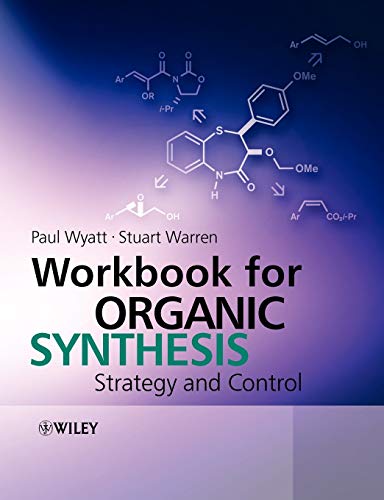
Workbook for Organic Synthesis (Paperback)
Stuart Warren
Sold by Grand Eagle Retail, Bensenville, IL, U.S.A.
AbeBooks Seller since October 12, 2005
New - Soft cover
Condition: New
Ships within U.S.A.
Quantity: 1 available
Add to basketSold by Grand Eagle Retail, Bensenville, IL, U.S.A.
AbeBooks Seller since October 12, 2005
Condition: New
Quantity: 1 available
Add to basketPaperback. Workbook for Organic Synthesis: Strategy and Control Paul Wyatt Senior Lecturer and Director of Undergraduate Studies, School of Chemistry, University of Bristol, UK Stuart Warren Reader in Organic Chemistry, Department of Chemistry, University of Cambridge, UK. Workbook for Organic Synthesis: Strategy and Control This workbook provides a comprehensive graded set of problems to illustrate and develop the themes of each of the chapters in the textbook Organic Synthesis: Strategy and Control. Each problem is followed by a fully explained solution and discussion. The examples extend the student's experience of the types of molecules being synthesised by organic chemists, and the strategies they employ to control their syntheses. By working through these examples students will develop their skills in analysing synthetic challenges, and build a toolkit of strategies for planning new syntheses. Together the workbook and textbook provide a complete course in advanced organic synthesis. Organic Synthesis: Strategy and Control Organic Synthesis: Strategy and Control is a sequel to Stuart Warren's bestseller Organic Synthesis: The Disconnection Approach. The 'Disconnection' book concentrated on the planning behind the synthesis of compounds. This book focuses on putting the planning into practice. The two themes of the book are strategy and control: solving problems either by finding an alternative strategy or by controlling any established strategy to make it work. The book is divided into five sections that deal with selectivity, carbon-carbon single bonds, carbon-carbon double bonds, stereochemistry and functional group strategy. Interpenetrating this structure, the 36 chapters start with classic methods and progress to modern methods and modern strategic considerations. Heterocyclic chemistry is treated throughout the book with full mechanistic explanations as part of organic chemistry rather than a separate entity. Students and professional chemists familiar with Organic Synthesis: The Disconnection Approach will enjoy the leap into a book designed for chemists at the coalface of organic synthesis. Workbook for Organic Synthesis: Strategy and Control Paul Wyatt Senior Lecturer and Director of Undergraduate Studies, School of Chemistry, University of Bristol, UK Stuart Warren Reader in Organic Chemistry, Department of Chemistry, University of Cambridge, UK. Workbook for Organic Synthesis: Strategy and Control This workbook provides a comprehensive graded set of problems to illustrate and develop the themes of each of the chapters in the textbook Organic Synthesis: Strategy and Control. Each problem is followed by a fully explained solution and discussion. The examples extend the student's experience of the types of molecules being synthesised by organic chemists, and the strategies they employ to control their syntheses. By working through these examples students will develop their skills in analysing synthetic challenges, and build a toolkit of strategies for planning new syntheses. Together the workbook and textbook provide a complete course in advanced organic synthesis. Organic Synthesis: Strategy and Control Organic Synthesis: Strategy and Control is a sequel to Stuart Warren's bestseller Organic Synthesis: The Disconnection Approach. The 'Disconnection' book concentrated on the planning behind the synthesis of compounds. This book focuses on putting the planning into practice. The two themes of the book are strategy and control: solving problems either by finding an alternative strategy or by controlling any established strategy to make it work. The book is divided into five sections that deal with selectivity, carbon-carbon single bonds, carbon-carbon Shipping may be from multiple locations in the US or from the UK, depending on stock availability.
Seller Inventory # 9780471929642
Dr Paul Wyatt, School of Chemistry, University of Bristol, Bristol
Dr Wyatt is Director of Undergraduate Studies for the School of Chemistry at Bristol University and also Director of BRISTOL ChemLabS - a HEFCE Centre for Excellence in Teaching & Learning.
Dr Stuart Warren, Department of Chemistry, University of Cambridge, Lensfield Road, Cambridge
Dr Warren is the author of the bestselling textbooks Organic Synthesis: The Disconnection Approach (Wiley) and Organic Synthesis (OUP)
"About this title" may belong to another edition of this title.
We guarantee the condition of every book as it¿s described on the Abebooks web sites. If you¿ve changed
your mind about a book that you¿ve ordered, please use the Ask bookseller a question link to contact us
and we¿ll respond within 2 business days.
Books ship from California and Michigan.
Orders usually ship within 2 business days. All books within the US ship free of charge. Delivery is 4-14 business days anywhere in the United States.
Books ship from California and Michigan.
If your book order is heavy or oversized, we may contact you to let you know extra shipping is required.
| Order quantity | 6 to 16 business days | 6 to 14 business days |
|---|---|---|
| First item | US$ 0.00 | US$ 0.00 |
Delivery times are set by sellers and vary by carrier and location. Orders passing through Customs may face delays and buyers are responsible for any associated duties or fees. Sellers may contact you regarding additional charges to cover any increased costs to ship your items.