
Synopsis
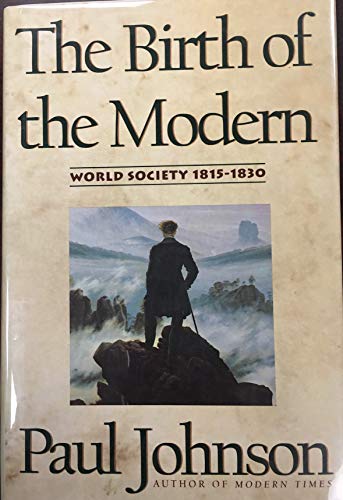
A popular history of the decade after Waterloo finds in it the seeds of the modern world, such as the establishment of constitutional democracy, international law, and other new ideas
"synopsis" may belong to another edition of this title.
Reviews
In 1815, on the eve of Napoleon's defeat at Waterloo, reactionaryism seemed triumphant everywhere, but by 1830 a decisive shift toward democracy had occurred. In the intervening 15 years, contends Johnson ( Modern Times ), the matrix of the modern world was formed: the U.S. became a global power, Russia expanded rapidly, Britain penetrated Arabia and the Middle East, Latin America threw off Spain's yoke, and an international order which would endure for a century took shape. This marvelously readable, vivid, immensely illuminating 1120-page chronicle of the epoch of Andrew Jackson, Wordsworth, Goya, Faraday, Beethoven and Bolivar is filled with startlingly original, provocative observations. For example, Johnson draws parallels between the destruction of Native Americans in the U.S. and Russia's genocide of Central Asian nomadic peoples. He also argues that Chinese opium addiction was not "a disease transmitted by the British" but the home-grown malady of an archaic society.
Copyright 1991 Reed Business Information, Inc.
A gargantuan panorama of the 15 transforming years immediately after the Napoleonic era, when ``peace came and immense new resources in finance, management, science and techology which were now available could be put to constructive purposes.'' Johnson (Intellectuals, 1989; A History of the Jews, 1987, etc.), a past editor of the New Statesman and the Spectator, is a master of vigorous narratives on epic topics. Astoundingly, he writes with fascination about events and movements in virtually all fields of human endeavor, whether the subjugation of Native Americans by Andrew Jackson, the scientific discoveries of Humphrey Davy, the compositions of Beethoven, the transparent innovations of George Stephenson and John McAdam, or such social phenomena as dueling, adultery, illegitimacy, and animal protectionism. He also throws an unexpected light on how artists and scientists formed a ``conjunction of minds'' by drawing on work in other fields (e.g., how intuitive speculations by Coleridge and Shelley about atomic and electromagnetic theory inspired the experimental science of Davy and Michael Faraday). Johnson's narrative and analytical skills even compensate for many dubious passages when his conservatism leads him to stretch for parallels between 19th- and 20th-century politics--for example, when he sees the genesis of the US-British ``special relationship'' at a moment when both nations continued to be wary of the other's attention, or likens Romantic admirers of Napoleon such as Shelley, Hazlitt, and Byron to intellectuals enamored of Stalinism in the 1930's. Maddeningly long and highly opinionated, but a lively and readable history of a world ``exhilarated and sometimes bewildered by the rapid changes which were transforming it.'' (Sixteen pages of photographs--not seen.) -- Copyright ©1991, Kirkus Associates, LP. All rights reserved.
Johnson is the author of several wide-ranging historical narratives. His best known is probably Modern Times ( LJ 5/1/83), and his most recent is Intellectuals (HarperCollins, 1988). This literally weighty but lively tome argues for the years 1815-30 as "those during which the matrix of the modern world was formed," citing developments like the rise of democracy and the separation of science from the broader culture. Johnson leaps from country to country, from politics to art to literature to medicine, in a fashion that makes for better browsing than consecutive reading. Not essential for smaller collections, but larger ones will want to continue to acquire the provocative Johnson output. Previewed in Prepub Alert, LJ 2/1/91.
- Nancy C. Cridland, Indiana Univ. Libs., Bloomington
Copyright 1991 Reed Business Information, Inc.
"About this title" may belong to another edition of this title.
Other Popular Editions of the Same Title

Search results for The Birth of the Modern: World Society, 1815-1830

Stock Image
The Birth of the Modern World
Seller: World of Books (was SecondSale), Montgomery, IL, U.S.A.
Seller rating 5 out of 5 stars

Condition: Acceptable. Item in acceptable condition! Textbooks may not include supplemental items i.e. CDs, access codes etc. Seller Inventory # 00100922729
Stock Image
The Birth of the Modern World
Seller: World of Books (was SecondSale), Montgomery, IL, U.S.A.
Seller rating 5 out of 5 stars
Condition: Good. Item in good condition and has highlighting/writing on text. Used texts may not contain supplemental items such as CDs, info-trac etc. Seller Inventory # 00094199906
Seller Image
The Birth of the Modern: World Society, 1815-1830
Seller: Dream Books Co., Denver, CO, U.S.A.
Seller rating 5 out of 5 stars
Condition: acceptable. This copy has clearly been enjoyedâ"expect noticeable shelf wear and some minor creases to the cover. Binding is strong, and all pages are legible. May contain previous library markings or stamps. Seller Inventory # DBV.006016574X.A
Stock Image
The Birth of the Modern: World Society, 1815-1830
Seller: SustainableBooks.com, Amherst, NY, U.S.A.
Seller rating 5 out of 5 stars
Condition: Fair. Book is in Used-Acceptable condition. Used items may not include supplementary materials such as CDs or access codes. Pages and cover may have wear, tears, and stickers. Pages are may contain notes and highlighting. Seller Inventory # 006016574X-2-5
Stock Image
The Birth of the Modern: World Society, 1815-1830
Seller: ThriftBooks-Dallas, Dallas, TX, U.S.A.
Seller rating 5 out of 5 stars
Hardcover. Condition: Good. No Jacket. Missing dust jacket; Pages can have notes/highlighting. Spine may show signs of wear. ~ ThriftBooks: Read More, Spend Less. Seller Inventory # G006016574XI3N01
Stock Image
The Birth of the Modern: World Society, 1815-1830
Seller: ThriftBooks-Phoenix, Phoenix, AZ, U.S.A.
Seller rating 5 out of 5 stars
Hardcover. Condition: Good. No Jacket. Missing dust jacket; Pages can have notes/highlighting. Spine may show signs of wear. ~ ThriftBooks: Read More, Spend Less. Seller Inventory # G006016574XI3N01
Stock Image
The Birth of the Modern: World Society, 1815-1830
Seller: ThriftBooks-Reno, Reno, NV, U.S.A.
Seller rating 5 out of 5 stars
Hardcover. Condition: Good. No Jacket. Missing dust jacket; Pages can have notes/highlighting. Spine may show signs of wear. ~ ThriftBooks: Read More, Spend Less. Seller Inventory # G006016574XI3N01
Stock Image
The Birth of the Modern: World Society, 1815-1830
Seller: ThriftBooks-Dallas, Dallas, TX, U.S.A.
Seller rating 5 out of 5 stars
Hardcover. Condition: Very Good. No Jacket. May have limited writing in cover pages. Pages are unmarked. ~ ThriftBooks: Read More, Spend Less. Seller Inventory # G006016574XI4N00
Stock Image
The Birth of the Modern: World Society, 1815-1830
Seller: ThriftBooks-Atlanta, AUSTELL, GA, U.S.A.
Seller rating 5 out of 5 stars
Hardcover. Condition: Good. No Jacket. Missing dust jacket; Pages can have notes/highlighting. Spine may show signs of wear. ~ ThriftBooks: Read More, Spend Less. Seller Inventory # G006016574XI3N01
Stock Image
The Birth of the Modern: World Society, 1815-1830
Seller: ThriftBooks-Atlanta, AUSTELL, GA, U.S.A.
Seller rating 5 out of 5 stars
Hardcover. Condition: Very Good. No Jacket. Former library book; Missing dust jacket; May have limited writing in cover pages. Pages are unmarked. ~ ThriftBooks: Read More, Spend Less. Seller Inventory # G006016574XI4N11